The process aims to reduce labor hours and material waste, dramatically cutting construction costs for new housing.


As Jonathan Hillburg reports in The Architect's Newspaper, "ICON and homebuilding company Lennar announced that they had partnered and will 3D print a 100-home neighborhood in Austin with BIG as the designer." The neighborhood will be the largest 3D-printed community built to date.
In an announcement made by the group, Hillburg writes, BIG partner Martin Voelkle said "[t]he 3D-printed architecture and the photovoltaic roofs are innovations that are significant steps towards reducing waste in the construction process, as well as towards making our homes more resilient, sustainable, and energy self-sufficient." The project's specific location and construction timeline are still unknown. ICON is currently building a 50-home social housing community in Nacajuca, Mexico, in a partnership with San Francisco-based nonprofit New Story.
In recent years, 3D printing has found a growing number of applications in urban planning and construction, with some proponents hailing it as a solution for the housing crisis. If successful at a larger scale, 3D-printed housing could significantly impact housing costs and reduce the carbon footprint of construction. Companies claim that 3D-printed homes can be built in under 24 hours (or a 95 percent reduction in labor hours) and produce up to ten times less waste, drastically reducing building costs.
FULL STORY: ICON and Lennar reveal the world’s largest 3D-printed community, designed by BIG

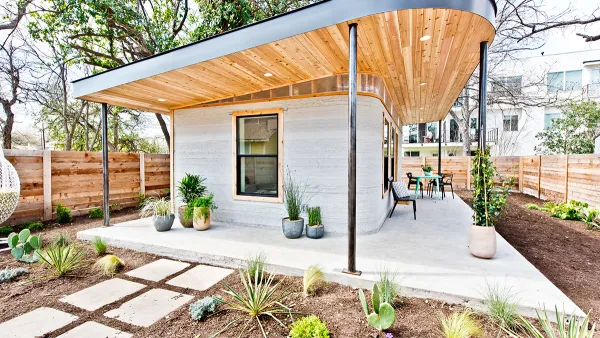
Coming Soon: A 3D-Printed Neighborhood
The march of progress continues.
3D Printing Affordable Housing at Scale
A new 3D printer, coming soon to the market, promises serious construction cost savings in an era of seriously expensive construction costs.

How 3D-Printing Can Make Housing More Affordable
Habitat for Humanity is working with 3D-printers to reduce the costs of construction and provide more housing for families in need.

Planetizen Federal Action Tracker
A weekly monitor of how Trump’s orders and actions are impacting planners and planning in America.

The state-sanctioned urbicide of Austin
People don’t kill cities. Freeways do.

US to reduce Colorado River water deliveries to Mexico
A new Colorado Treaty amendment reduces Mexico’s Colorado River water allocation by 250,000 acre feet.

5 New England states march closer to 800 megawatt wind energy project
Securing federal approval for the project may be complicated under the Trump administration, which has historically been hostile towards domestic wind power.

Baltimore to break ground on $50 million Transit Priority Project
The project will bring faster bus trips, safer streets and better bike connections to Baltimore.

Airbnb launches $250 million 'last-dollar financing' housing accelerator, makes first investment in Austin
The company will put $6.4 million towards affordable housing development in Texas’ capital.

FREE Course: Walkable City 1: Why Walkability?
After describing his path towards focusing on walkability as the essence of good planning, Jeff Speck marches through his five principal reasons for making more walkable places.
Reinventing Malls: Planning Alchemy—Turning Gray Fields Into Gold
The course focuses on the opportunities and imperatives that shape reinvention of mall sites.


Eagle County Government
Harvard University Graduate School of Design
Nashville Planning Department
The Architects Foundation
University of Cincinnati Online
The Pocatello Development Authority
The Urban Renewal Agency of the City of Pocatello
Journal of the American Planning Association