C.J. Gabbe at Santa Clara University and Greg Pierce at the University of California, Los Angeles write about their recently published article in the Journal of Planning Education and Research.



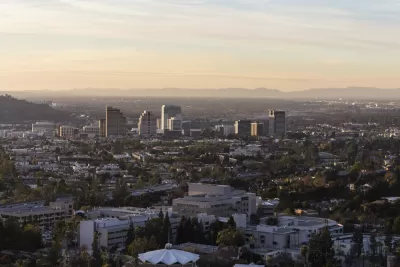
Adaptation to climate change—including extreme heat—is an essential topic for urban planners. Heat has consistently been the largest weather-related cause of death in the United States. People of color and those with lower incomes are disproportionately exposed to heat, and the largest health risks fall on seniors, young children, and those with chronic conditions. The U.S. experienced the hottest summer on record in 2021, including a six-day heat wave with some of the highest documented temperatures across the southwestern U.S., and an unprecedented heat wave in the Pacific Northwest that led to an estimated 600 excess deaths and thousands of hospitalizations.
Municipalities, which are home to nearly 63% of Americans and 76% of those residing in the western U.S., are central actors in climate adaptation planning. We recently co-authored research in JPER (along with Emily Petermann and Ally Marecek) to answer two questions about planning for extreme heat in California. First, what factors influence whether municipalities actively plan for extreme heat? Second, what kinds of heat-related planning and policy innovations have been adopted by municipalities? We answered these questions by analyzing the results of a 2018 survey by California's Office of Planning and Research, and evaluating four types of plans for the state's six largest cities.
Most California cities self-reported that they were not planning for urban heat. Only 37% of California cities reported having adopted urban heat island (UHI) policies; the rest either did not or the respondents were unsure. A likely explanation is that urban heat was not yet high on the radar of many planners. This may be changing as heat is increasingly on the agenda of professional organizations, including the American Planning Association and the Urban Land Institute, and is the subject of research in major planning journals.
Environmental and political factors influenced whether California cities adopted UHI policies. Most notably, the cities that were more likely to adopt UHI policies had more projected future extreme heat days, and reported greater local leadership on climate issues. Local leadership on climate change may also be self-reinforcing if initial planning efforts show results and foster subsequent planning efforts.
California's six largest cities engaged in heat adaptation planning in a variety of direct and indirect ways. Nearly all plans we reviewed identified extreme heat as an issue. The most common strategy, employed by all cities we analyzed, was expanding the urban tree canopy. The second most common strategy, broader urban greening efforts, were undertaken by nearly all cities. Many plans also included recommendations for "cool" roofing and paving materials intended to manage urban heat. Further, the six cities commonly deployed cooling centers and created educational and outreach programs. We are currently examining differences between larger and smaller cities' abilities to proactively plan for heat.
Social equity should be a central motivator for heat adaptation planning. We found mixed results on this front. Cities with environmental justice (EJ) in their general plans engaged in increased planning for climate adaptation and heat, yet there were no statistical associations between observed measures of environmental injustice and adaptation planning. We need to better understand mechanisms connecting race, ethnicity, and heat adaptation planning at the municipal and sub-municipal scales, including exploring our finding that cities with more Hispanic residents, all else equal, were less likely to have UHI policies. Within cities, heat adaptation planning should aim to eliminate thermal inequities—by race, ethnicity, and economic status—associated with increased exposure to extreme heat and disparities in public investments and resources.
Policymakers have an opportunity and a mandate to expand heat adaptation planning and associated investments. Municipalities can do much more to explicitly incorporate climate adaptation, including extreme heat, in their comprehensive/general plans, as well as into core city functions especially in outdoor maintenance, and in coordination with energy utilities which have a key role in heat adaptation. Municipalities can weave heat-related strategies into plan elements focused on land use, housing, circulation, open space, safety, environmental justice, and others. As heat adaptation planning is expanded, planners and policymakers should use urban heat as an opportunity to engage with local communities and direct investments to eliminate thermal inequity where they are needed most.


Planetizen Federal Action Tracker
A weekly monitor of how Trump’s orders and actions are impacting planners and planning in America.

Northwest rail fans eager for Sept. 30 debut of Amtrak’s Airo fleet
Get ready for that new train smell and more seats. But they won’t go faster or run more frequently on the Cascades route in Washington and Oregon.
Alabama scores up to $2.5 billion federal loan for largest infrastructure project in state’s history
The Mobile River Bridge and Bayway Project aims to ease congestion at Alabama’s worst bottleneck.

Novel study finds extreme state-by-state disparity in housing construction timelines
The first comprehensive working paper on U.S. construction timelines also found that the permitting process for multi-family projects has slowed nationwide.

California may destroy its beaches trying to save homes from El Niño
Boulders and seawalls can protect homes from waves, but ultimately destroy sandy beaches.

California high-speed rail accomplishes only one legislative goal in 2026
The majority of the agency's failed pitches were never developed into written proposals.

FREE Course: Walkable City 1: Why Walkability?
After describing his path towards focusing on walkability as the essence of good planning, Jeff Speck marches through his five principal reasons for making more walkable places.
Reinventing Malls: Planning Alchemy—Turning Gray Fields Into Gold
The course focuses on the opportunities and imperatives that shape reinvention of mall sites.

City of Thousand Oaks
City of Wisconsin Rapids
Harvard University Graduate School of Design
The Architects Foundation
University of Cincinnati Online
Northern Illinois Transit Authority (NITA)
The Pocatello Development Authority
The Urban Renewal Agency of the City of Pocatello

