The majority of the agency's failed pitches were never developed into written proposals.


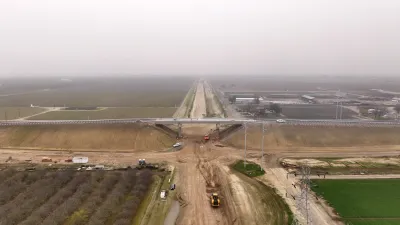
All but one of the legislative proposals that the California High-Speed Rail Authority deemed essential to keeping the construction of the rail line bridging Merced and Bakersfield on schedule failed to become law, Yue Stella Yu writes for Cal Matters. Authority Chief Executive Ian Choudri pitched several ideas that would allow the agency to tap into local tax revenue and fast track environmental reviews to speed up the project, many of which faced opposition from local governments.
Cal Matters reports that most of Choudri’s failed pitches “remained ‘concept-level ideas’ that the high-speed rail authority never developed into written proposals, said authority spokesperson Micah Flores. When asked why, Flores told CalMatters that the agency is not tasked with writing laws. ‘Legislators who learn about the concepts may choose or author legislation independently to help the project,’ he said.”
Voted first approved the high-speed rail project in 2008, with plans to build a line from Los Angeles to San Francisco by 2020. The CHSRA now estimates it will finish the project in 2040, and spend around four times as much as original estimates, at minimum. The line from Merced to Bakersfield is the first leg of the project.
Read the full story: California high-speed rail fails to accomplish most of its legislative goals for 2026


California High-Speed Rail Recommits to Bakersfield-to-Merced Segment
The California High-Speed Rail Authority also certified the Final Environmental Impact Report/Environmental Impact Statement for the San Francisco to San Jose section of the route in August.

Gov. Gavin Newsom to Dramatically Downsize High-Speed Rail Project
The San Francisco-to-Los Angeles bullet train may have to be renamed the Central Valley High-Speed Train according to the announcement by the new governor in his first state-of-the-state address.
California Budget Includes $4.2 Billion for High-Speed Rail
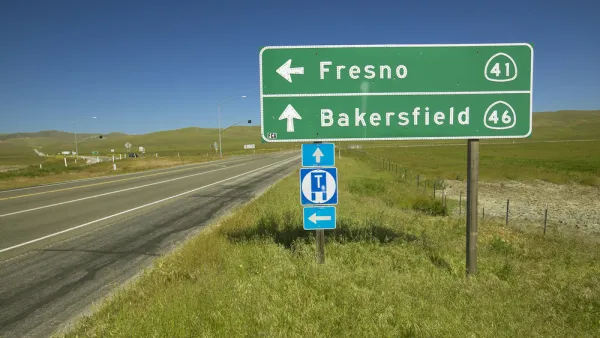
The recently approved state budget directs $4.2 billion in bond funding to the Bakersfield-to-Merced leg of California’s long-awaited high-speed rail project.

Planetizen Federal Action Tracker
A weekly monitor of how Trump’s orders and actions are impacting planners and planning in America.

Northwest rail fans eager for Sept. 30 debut of Amtrak’s Airo fleet
Get ready for that new train smell and more seats. But they won’t go faster or run more frequently on the Cascades route in Washington and Oregon.

Trump is considering data centers on 6 states' public land — some state officials say they had no idea
If the administration approves the proposed projects, data center and data center-related developments will cover 17,600 acres of public land.

California high-speed rail accomplishes only one legislative goal in 2026
The majority of the agency's failed pitches were never developed into written proposals.

Sharp cuts to federal passenger rail, public transit funding arrive today
The American Public Transportation Associations estimates the stopgap bill will result in an over 80% cut to federal passenger rail investment and 20% cut to public transit investment.

Chicago to showcase country’s first battery-operated passenger train
Metra estimates the trains will be ready for passenger use around the start of 2028.

FREE Course: Walkable City 1: Why Walkability?
After describing his path towards focusing on walkability as the essence of good planning, Jeff Speck marches through his five principal reasons for making more walkable places.
Reinventing Malls: Planning Alchemy—Turning Gray Fields Into Gold
The course focuses on the opportunities and imperatives that shape reinvention of mall sites.

City of Thousand Oaks
City of Wisconsin Rapids
Harvard University Graduate School of Design
The Architects Foundation
University of Cincinnati Online
Northern Illinois Transit Authority (NITA)
The Pocatello Development Authority
The Urban Renewal Agency of the City of Pocatello