A housing affordability case study, provided by the unique housing policies in the country of Sweden.



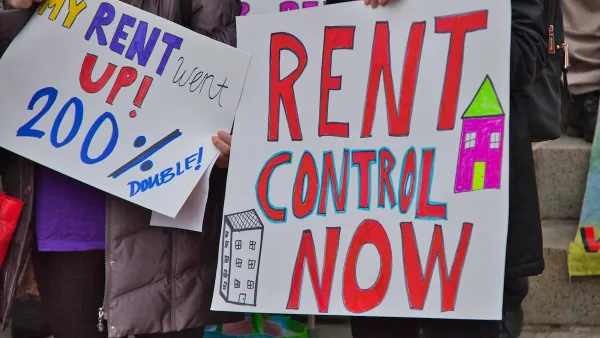
Maddy Savage reports from Sweden, where the country's nationwide rent control laws are failing to keep rents in line with the needs of the country's young population.
The country has been championing rent controls since World War II, according to Savage, along with laws that allow "collective bargaining between state-approved tenant and landlord associations."
But a "shortage of accommodations" in Stockholm and other Swedish cities "is causing a major headache for young Swedes," according to Savage.
Here's how the country's housing program works: "anyone can join a city's state-run queue for what Swedes call a 'first-hand' accommodation contract," according to Savage, and "Once you have one of these highly-prized contracts it's yours for life."
"But in Stockholm, the average waiting time for a rent-controlled property is now nine years, says the city's housing agency Bostadsförmedlingen, up from around five years a decade ago." Moreover: "This wait-time doubles in Stockholm's most attractive inner-city neighbourhoods."
To summarize: "Regulations designed to prevent owners from making long-term profits are also fuelling market instability."
What's Sweden's solution? They're building more housing. "Between 2015 and 2019, Stockholm gained 83,000 new homes, with construction increasing at an 'unusually high' rate, according to Länsstyrelsen, a state-run body which connects municipal and national authorities."
More on Sweden's unique housing policies and the country's real estate market, as well as comparisons to the rest of Europe, are included in the source article linked below.
FULL STORY: Why rent control isn’t working in Sweden


A Call for Action as Construction Slows in California
An editorial by the Los Angeles Times calls for the state to remove barriers to housing shortage after a report finds declining numbers of residential permits around the state.

LA Officials Struggle to Enforce Short-Term Rental Rules
Hundreds of rent-controlled units are being illegally rented out as short-term rentals, pushing out long-term renters and exacerbating the city’s housing crisis.
Biden Administration Proposes Federal Rent Hike Limits
A new policy would limit rent increases to 5 percent for landlords receiving federal tax write-offs.

The state-sanctioned urbicide of Austin
People don’t kill cities. Freeways do.

US to reduce Colorado River water deliveries to Mexico
A new Colorado Treaty amendment reduces Mexico’s Colorado River water allocation by 250,000 acre feet.

New Jersey’s second-largest city bans standalone data centers
Jersey City will continue to allow co-location facilities, such as those meant for research institutions that store their own data.

Amtrak not solely to blame for New Jersey commuter rail's unreliability, report finds
A new study from the Garden State Initiative found that NJ Transit’s budget grew 20% across a 4 year period, but reliability declined significantly over the same period.

EPA erases limits on planet-warming pollution from power plants
Under Monday’s plan, power plants would still have some limits on how much mercury, arsenic and other contaminants they can emit.

Phoenix announces new on-demand transit service, more frequent RAPID buses
Both new services will launch in October, and are part of Phoenix's Project Effective Access Solutions for Easing Congestion.

FREE Course: Walkable City 1: Why Walkability?
After describing his path towards focusing on walkability as the essence of good planning, Jeff Speck marches through his five principal reasons for making more walkable places.
Reinventing Malls: Planning Alchemy—Turning Gray Fields Into Gold
The course focuses on the opportunities and imperatives that shape reinvention of mall sites.

Eagle County Government
Harvard University Graduate School of Design
Nashville Planning Department
The Architects Foundation
University of Cincinnati Online
The Pocatello Development Authority
The Urban Renewal Agency of the City of Pocatello
Journal of the American Planning Association