A bridge in the works since the 1970s marks significant progress for active transportation in Portland, Oregon.


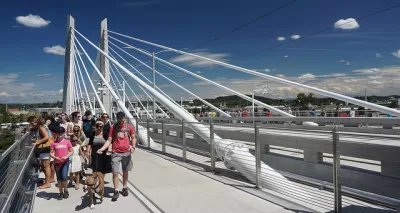
Jonathan Maus reports on the opening of a new pedestrian- and bike-only bridge in Portland.
The Flanders Crossing Bridge cost $9.5 million to span the Interstate 405 freeway. At 24 feet wide and 200 feet across, the bridge also has the distinction of being the only seismically resilient bridge across the freeway, according to Maus.
"It was built to withstand a 9.0 magnitude earthquake and is expected to be used by emergency vehicles in the event of a disaster," Maus.
Even better: "The bridge unlocks safe, convenient, access to tens of thousands of employees and residents in the Pearl and Northwest districts. This project is a massive win for the people of Portland, our economy, and our planet."
What's more, the new bridge comes with a substantial investment in the bikeway that connects to the bridge. "There are new signals at 15th and 16th as well as new lane striping and traffic calming that will reduce the number of drivers on Flanders and make bicycle riding less stressful," reports Maus. "It’s a rare neighborhood greenway in the central city."
FULL STORY: The Flanders Bridge is open for business

Portland and Multnomah County Push for Lower Speed Limits on Bridges
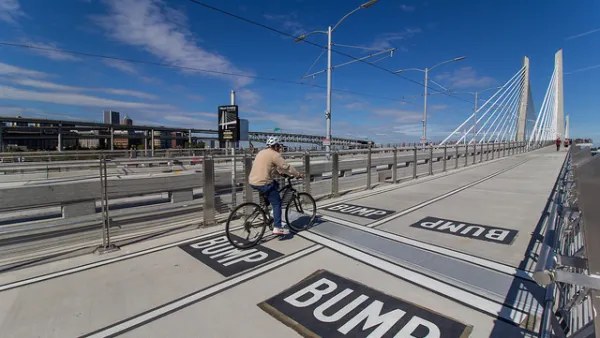
The Portland Bureau of Transportation and Multnomah County agree on a 30 mph speed limit on five downtown bridges, but the state's department of transportation denied the change on two key spans.
Dallas' Margaret McDermott Bridge Finally Open to Pedestrians and Cyclists
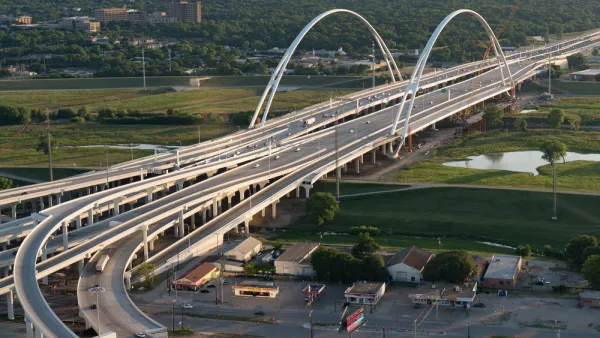
Overdue and over budget, infrastructure for pedestrian and people on bikes is finally available on the Margaret McDermott Bridge in Dallas.
Portland, Ore. Voters Will Be Asked to Reauthorize Gas Tax in May 2020
Originally approved by 52 percent of voters in May 2016, the 4-year, 10 cents per gallon city gas tax has outperformed revenue projections. Funds are split between road maintenance and bike and pedestrian projects.

The state-sanctioned urbicide of Austin
People don’t kill cities. Freeways do.

US to reduce Colorado River water deliveries to Mexico
A new Colorado Treaty amendment reduces Mexico’s Colorado River water allocation by 250,000 acre feet.

New Jersey’s second-largest city bans standalone data centers
Jersey City will continue to allow co-location facilities, such as those meant for research institutions that store their own data.

Amtrak not solely to blame for New Jersey commuter rail's unreliability, report finds
A new study from the Garden State Initiative found that NJ Transit’s budget grew 20% across a 4 year period, but reliability declined significantly over the same period.

EPA erases limits on planet-warming pollution from power plants
Under Monday’s plan, power plants would still have some limits on how much mercury, arsenic and other contaminants they can emit.

Phoenix announces new on-demand transit service, more frequent RAPID buses
Both new services will launch in October, and are part of Phoenix's Project Effective Access Solutions for Easing Congestion.

FREE Course: Walkable City 1: Why Walkability?
After describing his path towards focusing on walkability as the essence of good planning, Jeff Speck marches through his five principal reasons for making more walkable places.
Reinventing Malls: Planning Alchemy—Turning Gray Fields Into Gold
The course focuses on the opportunities and imperatives that shape reinvention of mall sites.

Eagle County Government
Harvard University Graduate School of Design
Nashville Planning Department
The Architects Foundation
University of Cincinnati Online
The Pocatello Development Authority
The Urban Renewal Agency of the City of Pocatello
Journal of the American Planning Association