New amendments to the D.C. Comprehensive Plan set goals for new housing development and fewer cars on the road.



Libby Solomon reports: "DC Council has been working for years to update the Comprehensive Plan, DC’s enormous zoning and land-use document. On Tuesday, those years of work concluded in a unanimous vote on an update to the document, which dates back to 2006."
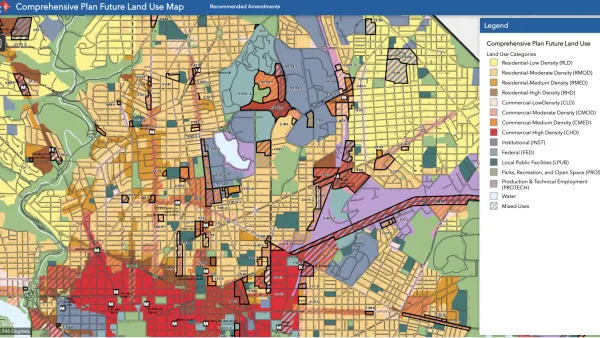
Solomon helpfully notes that the approved amendments to the D.C. Comprehensive Plan don't change any zoning, but they will guide decisions about land use, zoning, and growth in the future.
And the amendments set the nation's capital decisively in the direction of more zoned capacity for development. In an article by Julia Zauzmer earlier this month, D.C. Planning Director Andrew Trueblood is quoted saying that the new amendments to the D.C. Comprehensive Plan would allow for as much as 15 percent more housing stock. Other innovative goals set by the update include plans to reduce the number of cars on the road and explore congestion pricing.
Solomon's coverage of the big comp plan update includes a discussion of the racial equity issues that played a central role in the political debate leading up to this week's vote. An April report from the Council Office of Racial Equity (CORE) faulted the plan amendments for failing to adequately address issues of racial equity. "Some of the last-minute changes the Council approved Tuesday were meant to address those concerns," according to Solomon. "One major change in Council Chairman Phil Mendelson’s Tuesday amendment to the bill: defining 'deeply affordable' housing as housing affordable to families making less than 40% of the Median Family Income (MFI)."
Solomon concludes by looking forward to next steps, with the amended comp plan only a first step toward achieving the goals laid out in the plan. With this update process now complete, Solomon reports that a full rewrite process will being in 2025.
Read the full story: DC Council passes Comprehensive Plan update unanimously
D.C. Comprehensive Plan Update Needs Equity Improvements, Report Says
The new D.C. Office of Equity has produced an evaluation of proposed changes to the D.C. Comprehensive Plan.

Comprehensive Plan Update Stokes Controversy in D.C.
Complex political dynamics are mustering for a showdown over D.C.'s comprehensive plan.

D.C. Comp Plan Update Includes 'Gentle Density' in Single-Family Residential Neighborhoods
A lot of long-term planning is underway in Washington, D.C.

Planetizen Federal Action Tracker
A weekly monitor of how Trump’s orders and actions are impacting planners and planning in America.

California plans to bury El Niño’s downpour
If the state plays its cards right, it may be able to store a billion acre-feet of El Niño’s water in aquifers.

Desperate measures: Advocates weigh draining Lake Powell to fill Colorado River
Draining the reservoir could reduce evaporation losses by a couple hundred thousand acre-feet.

Chicago voters approve permanent festival grounds, penalty for vacant property owners
Currently, major summer and fall festivals take over public parks for weeks at a time, drawing criticism from nearby residents

NYC votes to cut outdoor dining red tape, speed up permitting
New York City also voted to allow the Department of Transportation to begin work on urgent projects before notifying elected officials.

California appears to reject Prop. 45
The proposition would have expanded the projects that qualify for a streamlined environmental review, effectively paring down the California Environmental Quality Act.

FREE Course: Walkable City 1: Why Walkability?
After describing his path towards focusing on walkability as the essence of good planning, Jeff Speck marches through his five principal reasons for making more walkable places.
Reinventing Malls: Planning Alchemy—Turning Gray Fields Into Gold
The course focuses on the opportunities and imperatives that shape reinvention of mall sites.

City of Rosemead
Rutgers University, Edward J. Bloustein School of Planning and Public Policy
One Hundred Miles
Hunter College, City University of New York (CUNY)
The Architects Foundation
University of Cincinnati Online
City of Cambridge
Montrose County
The Pocatello Development Authority