To fix the housing crisis, cities should focus on "missing middle housing" and multi-family development.



Jake Bullinger, in a piece for In These Times, assesses some of the upzoning programs being implemented by many cities in the American West as they struggle to get a handle on the growing housing affordability crisis.
The "regulatory and economic cocktail" that leads developers to "go big and expensive" and prevents multi-unit development near major job centers, writes Bullinger, has led to huge imbalances in housing availability and cost. "In some areas of California, for instance, new jobs have outnumbered new homes 12 to 1." Restrictive single-family zoning policies, the kind that cities across the country are currently reevaluating, have stifled new housing construction and deepened the crisis by preventing mid- and high-density development in some of the most resource-rich parts of cities.
"In an efficient market, developers would build apartments where land is expensive and rent is high — the developer gets more revenue-generating units per parcel, and renters get the option of smaller, less-expensive housing. But that hasn’t been the case in California: nine of the state’s 12 most expensive cities permitted zero multifamily units between 2013 and 2017." With the need for more housing options growing every day, says Bullinger, "a corner-lot fourplex on every block could go a long way."
Read the full story: Towns Across the West Face a Housing Crisis. More Sprawl Is Not the Answer.
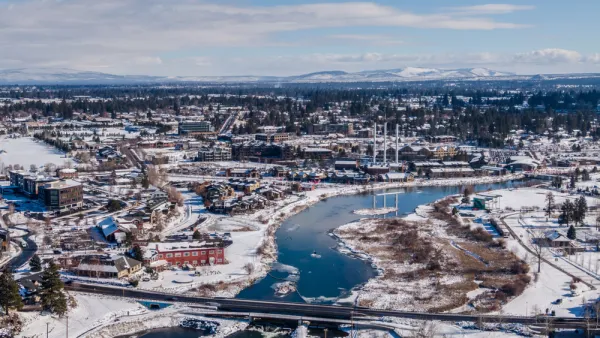
Upzoning Leads to Sharp Growth in Construction in Bend
After Oregon legalized 'missing middle housing' in cities statewide, Bend, the first city to comply with the state law, has experienced a significant boost in mid-density housing construction.
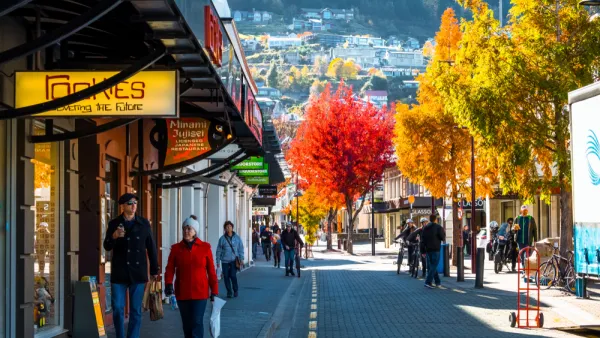
Zoning Reform: Lessons From New Zealand
The island nation is mandating mid-density zoning requirements and transit-oriented development in an effort to increase housing affordability and encourage compact development.
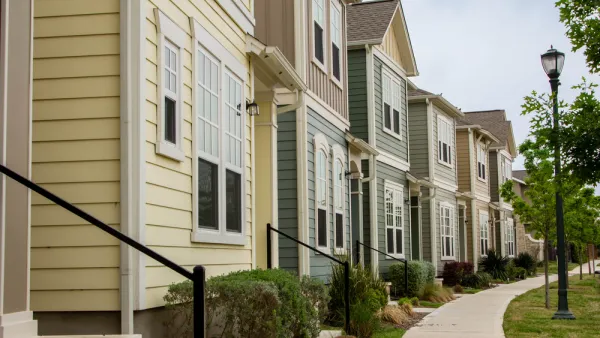
Blanket Upzoning: A Solution to Housing Pressures?
Mass upzoning could give developers and homeowners the flexibility to build new housing where it's most needed.

Planetizen Federal Action Tracker
A weekly monitor of how Trump’s orders and actions are impacting planners and planning in America.

California plans to bury El Niño’s downpour
If the state plays its cards right, it may be able to store a billion acre-feet of El Niño’s water in aquifers.

Desperate measures: Advocates weigh draining Lake Powell to fill Colorado River
Draining the reservoir could reduce evaporation losses by a couple hundred thousand acre-feet.

Mamdani’s pied-à-terre tax survives legal challenge
A panel of judges found that the plaintiffs failed to demonstrate injury as a result of New York City's implementation of the tax.

Eastern Nebraska is running out of electricity
Data centers and electrification are straining eastern Nebraska’s grid, throttling economic development.

Seattle passes record-breaking transit services expansion
Proposition 1 will double the city’s transit tax to add 95,000 more bus trips and preserve 180,000 bus trips annually.

FREE Course: Walkable City 1: Why Walkability?
After describing his path towards focusing on walkability as the essence of good planning, Jeff Speck marches through his five principal reasons for making more walkable places.
Reinventing Malls: Planning Alchemy—Turning Gray Fields Into Gold
The course focuses on the opportunities and imperatives that shape reinvention of mall sites.

City of Rosemead
Rutgers University, Edward J. Bloustein School of Planning and Public Policy
One Hundred Miles
University of Michigan School for Environment and Sustainability (SEAS)
Hunter College, City University of New York (CUNY)
The Architects Foundation
City of Cambridge
Montrose County
The Pocatello Development Authority