The wildfires burning throughout the West, with terrible but photogenic consequences, come with a reminder that it's only going to get worse unless massive changes are made right here in the United States.



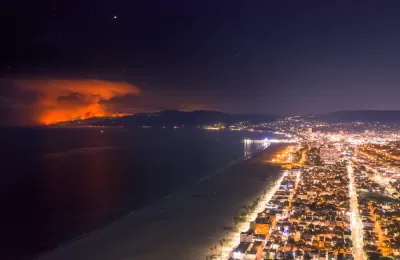
[Updated September 14, 2020 and September 16, 2020 with several new articles in the concluding list below.]
Even without a pandemic hovering in the background like muzak on loop, the consequences of fire season seem to get worse every year in the West. The fires get bigger, more destructive, and deadlier. The smoke chokes cities for more days every year. Rain falls less frequently. The hottest days just get hotter. I'm a native Californian, so I'm living through these surreal and scary days of smoke and ash with a sense of familiar dread, once again checking with friends and family who have evacuated from fires and nervously refreshing real-time fire incident reports and air quality data. Broken records lose their novelty when they barely last a year.
Though they seemed like a new level of climate change revealed, the images emerging in the past week of orange skies over the Bay Area, residents fleeing cities in Oregon, and campers trapped by Alpine lakes are just the latest in a steady stream of apocalyptic images from the American West. Remember the charred remains of the Wine Country and Butte County. Remember the images of golfers teeing it up in Oregon while forests burned in the background. Remember the pre-dawn commute on Interstate 405 in Los Angeles that resembled something from Hollywood's worst nightmares. Remember the dam that almost burst on the rare occasion of a steady dose of rain. The skies turned orange in Australia less than a year ago. The consequences of climate change are spreading, and its roots are digging deeper and deeper into the planet. But none of this is new. Novelty is now reality.
California, Oregon, Washington, and Colorado are currently bearing the brunt of the entire country's neglect of the environment. Soon again it will be the Atlantic Coast’s, or the Gulf Coast's, turn to pay this terrible price for a century's worth of modern convenience. We should all see each other in these moments of reckoning. Scientists know why these fires are burning so much bigger and destroying so many more lives every year. We the public have the power to do something about it.
If it feels like there is no escape, remember that the choices Americans make about where and how they live, where and how they develop new places for living and working, and how they get to and from, are now the main causes of the climate crisis. We know what we have to do to correct the path we are on, but we are still headed the wrong direction.
Recent articles on the causes and consequences of climate change and wildfire follow.
- Welcome to the ‘Pyrocene,’ an Epoch of Runaway Fire (Bloomberg CityLab, August 27, 2020)
- They Know How to Prevent Megafires. Why Won’t Anybody Listen? (ProPublica, August 28, 2020)
- Wildfires are getting worse. Will forests start to burn themselves out? (Grist, September 2, 2020)
- Editorial: Wildfires and soaring temperatures — the hellscape scientists warned us about is here (Los Angeles Times, September 9, 2020)
- The Bay Area Just Turned Orange. All Eyes Are on PurpleAir (Wired, September 9, 2020)
- The orange skies and smoky air from Western wildfires, explained (Vox, September 9, 2020)
- Photos: Wildfires burning near Tacoma suburbs (KUOW, September 9, 2020)
- Thousands evacuate, at least 4 killed as Oregon wildfires burn over 800 square miles (The Oregonian, September 10, 2020)
- Rarely have so many Californians been exposed to such gloomy, unhealthy air (Los Angeles Times, September 10, 2020)
- Massive August fire now largest in California history, at 471,000 acres and counting (Los Angeles Times, September 10, 2020)
- The Day the Sky Turned Orange (Bloomberg CityLab, September 10, 2020)
- Why Firefighting Alone Won't Stop Western Mega-Fires (NPR, September 11, 2020)
- A Self-Perpetuating Cycle of Wildfires (The New York Times, September 11, 2020)
- In Oregon, a Year of Political Tumult Extends to Devastating Wildfires (The New York Times, September 11, 2020)
- The future has arrived. These explosive fires are our climate change wakeup call (The Guardian, September 11, 2020)
- 10 Dead as California Fire Becomes Deadliest of Year (Associated Press, September 11, 2020)
- Washington state’s wildfires have now destroyed more than 626,000 acres, 181 homes (The Seattle Times, September 11, 2020)
- First views behind the fire lines along McKenzie River ‘shocking and numbing’ (The Oregonian, September 12, 2020)
- Warmer. Burning. Epidemic-challenged. Expensive. The California Dream has become the California Compromise. (The Washington Post, September 12, 2020)
- How climate change is fueling record-breaking California wildfires, heat and smog (Los Angeles Times, September 13, 2020)
- The worst fire season ever. Again. (Los Angeles Times, September 15, 2020)
- Climate change has brought a ‘new era of megafire,’ and we’re failing to adapt (The Washington Post, September 16, 2020)

More Colorado Suburbs at Risk for Wildfires
Experts warn that more intense fires fueled by a warming climate are threatening an increasing number of Colorado's suburban communities.
Over a Quarter of US Homes Face ‘Severe or Extreme’ Climate Risk
The number of U.S. homes at risk from hurricanes, fires, or flooding is valued at close to $13 trillion.
Lawmakers Call for Improved Air Quality Monitoring in LA Following Fires
Wildfires like those in Los Angeles that destroy urban structures release toxic chemicals, including lead, into the air.

Planetizen Federal Action Tracker
A weekly monitor of how Trump’s orders and actions are impacting planners and planning in America.

California plans to bury El Niño’s downpour
If the state plays its cards right, it may be able to store a billion acre-feet of El Niño’s water in aquifers.

Chicago breaks ground on $3 billion megadevelopment
The new neighborhood, titled Foundry Park, will one day host 3,700 residences.

California High-Speed Rail Authority CEO resigns after $600,000 scandal
Under Ian Choudri, the authority used taxpayer dollars to fund first class flights and trips to nightclubs.

Want to study the Missouri River? Soon, you may need unanimous approval from 10 states
Legislation would require 10 governors’ permission to study or build projects moving water outside the basin.

Desperate measures: Advocates weigh draining Lake Powell to fill Colorado River
Draining the reservoir could reduce evaporation losses by a couple hundred thousand acre-feet.

FREE Course: Walkable City 1: Why Walkability?
After describing his path towards focusing on walkability as the essence of good planning, Jeff Speck marches through his five principal reasons for making more walkable places.
Reinventing Malls: Planning Alchemy—Turning Gray Fields Into Gold
The course focuses on the opportunities and imperatives that shape reinvention of mall sites.

City of Rosemead
Rutgers University, Edward J. Bloustein School of Planning and Public Policy
One Hundred Miles
Hunter College, City University of New York (CUNY)
The Architects Foundation
University of Cincinnati Online
City of Cambridge
Montrose County
The Pocatello Development Authority

