Public meetings often disprove the notion that communities have a unified stance on any issue. With this in mind, we must move past trying to find consensus and focus on uplifting the most marginalized voices.


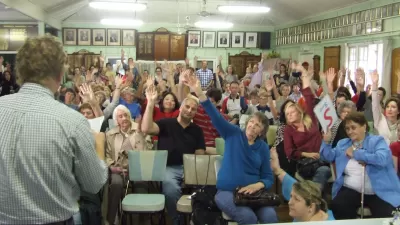
When it comes to community development projects in poor urban neighborhoods, practitioners and scholars often ask a seemingly simple question: what does the community want? Since the 1960s and the War on Poverty, the community development field has embraced (to at least some extent) the idea of “community control.” Rooted in the Black Power Movement, community control originally referred to Black people reclaiming control over schools, businesses, and other institutions that affect Black neighborhoods. Today, community control is a normative idea that the community—broadly defined—should have a say and determine neighborhood priorities. While developers sometimes agree to formal contractual obligations like community benefits agreements (CBAs), no mechanism of achieving community control has been more common than the public meeting.
Critiques of participatory processes abound. Political scientists Katherine Einstein, David Glick, and Maxwell Palmer find that public meeting participants tend to be white homeowners—meaning public meetings will disproportionately serve white homeowners’ interests. Sociologist Michael McQuarrie argues that community-based organizations, motivated by organizational survival, use participation and consensus organizing to establish legitimacy and curry favor with funders. As a result, participation tends to support elite authority rather than challenge it. Focusing on affordable housing debates in the Bay Area, New York Times journalist Conor Dougherty shows how public meetings are in effect veto points that can block new development. New projects generally require community agreement in order to move forward, and so all it takes is a handful of opponents to signal a lack of consensus. By design, then, public meetings give the people who say “no” a much louder voice than the people who say “yes.”
For most observers, the solutions are technical. More meetings. Better attended meetings. Differently designed meetings. In short, the challenge is to fine-tune public meeting practices in ways that elevate the authentic voice of the community.
While conducting research for my book, tentatively titled Constructing Community and forthcoming with Princeton University Press, I came to question these and other assumptions. I spent four years conducting fieldwork in some of Boston’s highly segregated and disadvantaged neighborhoods. I wanted to understand who made important decisions about affordable housing, public transit, economic development, and open recreational space. I was particularly interested in the relationship between public participation and community control.
I argue that no participatory process can accurately reflect the voice of the community, no matter how well run. The reason is fundamental: there is no such thing as “the” community. As sociologists Mary Pattillo and Monica Bell persuasively show in separate studies, opinions and experiences with institutions vary, even in demographically segregated neighborhoods. To say that “the community” is in support of anything is a misnomer.
Community development practitioners, by contrast, generally assume there is in fact a community that has a voice; community control requires the community to control development, after all. When those in power circumvent participating community members, it is clear community control has not been achieved. But how do we evaluate community control when some community members might oppose a project that others pursue—did the community control the project in those cases?
...
Read the full story: It’s Time to Move On From Community Consensus

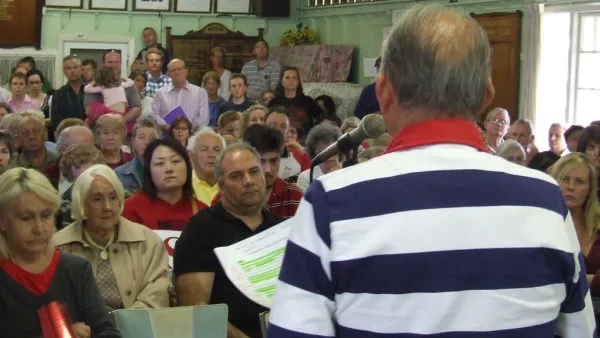
The State of Public Meetings
Dating back to a tradition begun in the 1630s, public meetings are an essential part of the political systems, and planning processes, of U.S. cities. Public meetings are also broken, according to this article.
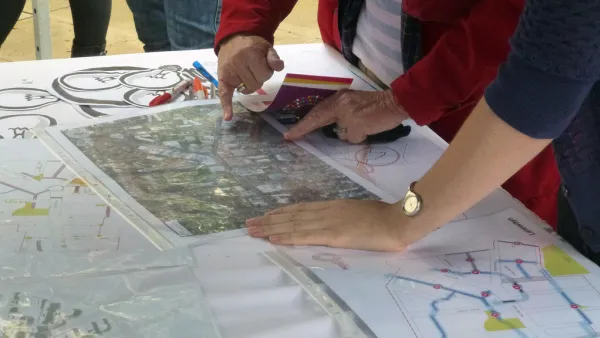
How to Improve Charrettes
In participatory planning, there is no planning without several events known as charrettes, which you probably already knew. Less likely to be common knowledge, however, is how charrettes can live up to their promise in the planning process.
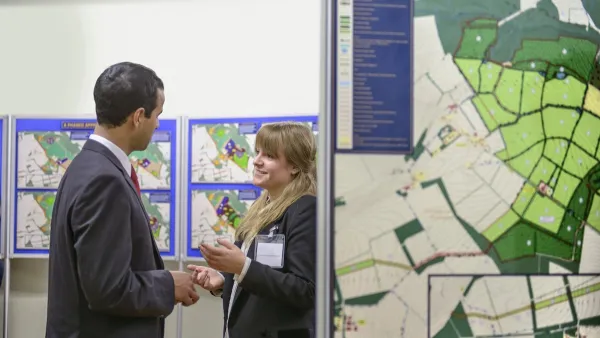
The Problem With Outsourcing Public Engagement
Why hiring outside consultants to represent public works projects at meetings often misses the point of having public officials hear community concerns.

Planetizen Federal Action Tracker
A weekly monitor of how Trump’s orders and actions are impacting planners and planning in America.

The state-sanctioned urbicide of Austin
People don’t kill cities. Freeways do.

US to reduce Colorado River water deliveries to Mexico
A new Colorado Treaty amendment reduces Mexico’s Colorado River water allocation by 250,000 acre feet.

Nation's most wind-powered state turns to coal as data centers increase energy demand
For the first time in decades, Iowa has increased its generation of coal power.

NYC cools commuters with city's first rain garden above a bus stop
New York City officials say the plants in the rain garden can absorb 16 gallons of rainwater during heavy storms.

Brightline West’s future may rely on $6 billion federal loan
The company has until Nov. 2 to make a $400 million equity investment into its proposed high-speed rail line.

FREE Course: Walkable City 1: Why Walkability?
After describing his path towards focusing on walkability as the essence of good planning, Jeff Speck marches through his five principal reasons for making more walkable places.
Reinventing Malls: Planning Alchemy—Turning Gray Fields Into Gold
The course focuses on the opportunities and imperatives that shape reinvention of mall sites.

Eagle County Government
Harvard University Graduate School of Design
Nashville Planning Department
The Architects Foundation
University of Cincinnati Online
The Pocatello Development Authority
The Urban Renewal Agency of the City of Pocatello
Journal of the American Planning Association