The pandemic delayed the 2020 Census, and the Trump administration will cut it short. Experts say this could be the most flawed Census in the country's history.



"The Census Bureau has announced plans to cut its 2020 counting efforts short by a full month, sparking fears that many, including people of color and immigrants, could be left out this year," reports Chantal Da Silva.
"In a statement published on Monday evening, the Census Bureau said it would be ending its field data collection by September 30, a month earlier than had been expected," adds Da Silva.
The Census Bureau's response to the coronavirus pandemic forced a delay of door-to-door counting operations in April, among other changes, potentially delaying redistricting processes that depend on Census data in the following year.
"With the Trump administration’s decision to end the 2020 census count four weeks early, the Census Bureau now has to accomplish what officials have said it cannot do: accurately count the nation’s hardest-to-reach residents — nearly four of every 10 households — in just six weeks," according to an article by Michael Wines and Richard Fausset that provides additional news coverage of the Trump administration's move to cut the Census short, and how that will impact Census workers and residents of the country.
"The result is both a logistical challenge of enormous proportions that must take place in the middle of a pandemic, and yet another political crisis for the census, historically a nonpartisan enterprise. The announcement, which came Monday evening, immediately generated sharp criticism," add Wines and Fausset.
Much of the criticism was shared int he media, like an editorial from the New York Times claiming that Trump believes the Republican party's political fortunes will be improved by undercounting hard to reach populations of racial minorities and immigrants. That might be a mistaken assumption:
But the irony is that a rush to finish the counting process could hurt Mr. Trump’s own voters, too. That’s because the poorest states, which depend the most on federal funding, also tend to have lower census response rates. In West Virginia, federal funding from programs tied to the census accounted for 17 percent of economic activity in 2017, according to Mr. Reamer’s calculations. The state has one of the lowest census response rates.
According to an explainer post of the Trump administration, provided by Nicole Narea for Vox, the 2020 Census is shaping up to be one of the most flawed Census counts in history. An opinion piece for The Washington Post by Vanita Gupta, president and chief executive officer of the Leadership Conference on Civil and Human Rights, calls on Congress to intervene to ensure that the Census is able to complete its process and undertake an accurate count. An article by William H. Frey, also highly critical of the Trump administration's decision to cut the count short, also reports that the decision is being challenged in court by the New York Immigration Coalition, among others.
As reported by Adam K. Raymond, a #StealTheCensus hashtag has emerged on social media for U.S. residents to express their concerns.
As noted by many of these media outlets since the news broke about the decision to cut the count short, the Trump administration has been actively obstructing the Census since long before the pandemic began to rage across the country. Planetizen documented the Trump administration's obstructions in the following article.
- Updated: Supreme Court Falls Short of Clarity on Census Citizenship Question (June 27, 2019)
- Explained: The Risks Facing the 2020 Census (February 6, 2018)
- 'High Risk' of Failure: The 2020 Census (September 6, 2017)
- Turmoil at the U.S. Census Bureau as Director Resigns (May 10, 2017)
FULL STORY: Census Bureau to Cut 2020 Count Short, Sparking Fears Many Will Be Left Out

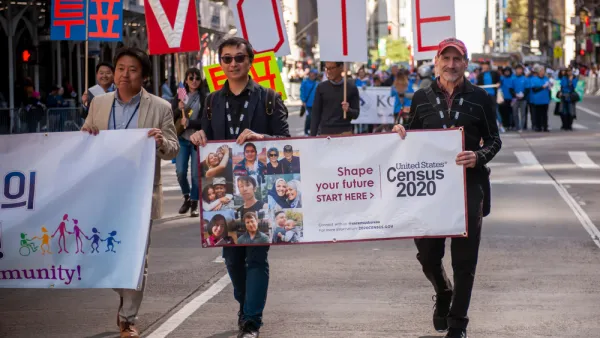
Another Delay for the Census: Now Expected for September Delivery
The pandemic and political mismanagement are continuing to have an effect on the 2020 Census.
Census Bureau Seeks Delay
Citing complications from the coronavirus pandemic, the U.S. Census Bureau is seeking a 120-day delay in concluding the Census process, with potential consequences lasting into 2021.
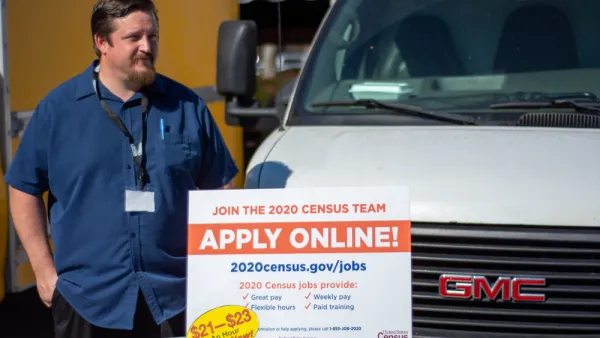
2020 Census Adapting Quickly to the Coronavirus Pandemic
Delayed operations and recommendations for how college students should report their living conditions are key to the Census response to COVID-19 so far. The Census is still expected to wrap up by the end of July 2020.

The state-sanctioned urbicide of Austin
People don’t kill cities. Freeways do.

US to reduce Colorado River water deliveries to Mexico
A new Colorado Treaty amendment reduces Mexico’s Colorado River water allocation by 250,000 acre feet.

New Jersey’s second-largest city bans standalone data centers
Jersey City will continue to allow co-location facilities, such as those meant for research institutions that store their own data.

Amtrak not solely to blame for New Jersey commuter rail's unreliability, report finds
A new study from the Garden State Initiative found that NJ Transit’s budget grew 20% across a 4 year period, but reliability declined significantly over the same period.

EPA erases limits on planet-warming pollution from power plants
Under Monday’s plan, power plants would still have some limits on how much mercury, arsenic and other contaminants they can emit.

Phoenix announces new on-demand transit service, more frequent RAPID buses
Both new services will launch in October, and are part of Phoenix's Project Effective Access Solutions for Easing Congestion.

FREE Course: Walkable City 1: Why Walkability?
After describing his path towards focusing on walkability as the essence of good planning, Jeff Speck marches through his five principal reasons for making more walkable places.
Reinventing Malls: Planning Alchemy—Turning Gray Fields Into Gold
The course focuses on the opportunities and imperatives that shape reinvention of mall sites.

Eagle County Government
Harvard University Graduate School of Design
Nashville Planning Department
The Architects Foundation
University of Cincinnati Online
The Pocatello Development Authority
The Urban Renewal Agency of the City of Pocatello
Journal of the American Planning Association