As the infection rate at jails in places like New York began to climb, officials started looking for criteria to use in determining which inmates could be released. Then they ran into a familiar but now heightened dilemma.



In March, as the reality of just how deadly and widespread the novel coronavirus would be began to sink in, advocates and service providers who work with prison and jail inmates began sounding alarm bells across the country: prisons were sure to become death pits. Eight of the 10 infection hot spots nationally are jails and prisons, according to The New York Times.
The infection rate in New York City’s Rikers Island jail is 8.14 percent compared to 1.31 percent in the city as a whole, according to The Legal Aid Society, a nonprofit that provides legal assistance to vulnerable and underserved populations. On May 6, the state’s Department of Corrections and Community Supervision reported a total of 1,143 staff infected statewide, plus 415 prisoners and 53 parolees. Four staff members have died due to the infection, as well as 15 inmates and four parolees. As testing of the inmate population appears to be drastically lacking and many people with the infection can be asymptomatic, advocates expect that the numbers are actually much higher.
Inmates in prisons and jails across New York describe squalid conditions where they are still forced to interact with fellow inmates, must wrap their faces with scarves or fabric scraps, and are told to clean their own rooms but are given no cleaning supplies. Visits from family members and lawyers to these facilities are banned. Guards, too, complain they have not been given personal protective gear, or have been told they are not allowed to wear it, yet are still required to perform highly invasive contraband checks.
As the infection rate at jails in states like California and New York, where the virus first took hold, began to climb and inmates got word out to the public about the conditions they are living in, officials began, grudgingly, looking for criteria to use in determining which categories of inmates to release. And then they ran into a familiar but now heightened dilemma—finding housing for the formerly incarcerated is never easy.
Inmates who are being paroled or released early must have a housing plan arranged before they can walk out of prison. Typically, this is done via family, lawyers, or nonprofit groups that arrange a living situation. “They don’t release someone to the street,” says Anthony Dixon, director of community engagement for the Manhattan-based Parole Preparation Project. “A parole officer has to go to [the place they intend to live] prior to release to check it out to make sure there are no drugs … that it will be a place that won’t present problems.”
Finding this type of housing can be a challenge during normal times, but Dixon says with the system now handling those who were already scheduled to be paroled, as well as those released due to COVID-19, there is an overflow.
....
FULL STORY: Pandemic Leads to Early Prisoner Release; Finding Housing Remains Difficult


Biden Signs Legislation Ending Covid 19 National Emergency
The Covid 19 national emergency enacted by then-President Donald Trump in March 2020 was officially ended on Monday by President Joe Biden.

Report: Pandemic Migration Accelerated Existing Trends
Despite some transformative changes and brief spikes in domestic migration, the Covid-19 pandemic seems to be exacerbating existing declines in internal mobility.
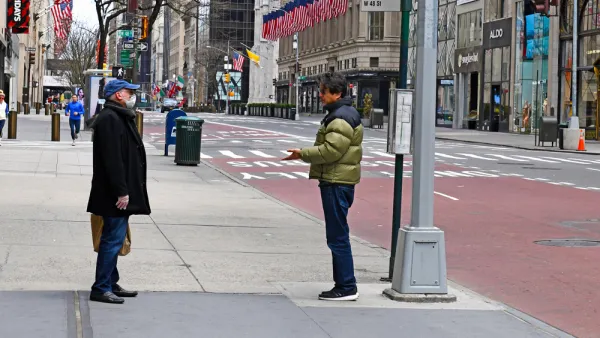
Friday Eye Candy: Covid-19, Then and Now
The New York Times compared images from readers portraying similar scenes in 2020 and 2022.

Planetizen Federal Action Tracker
A weekly monitor of how Trump’s orders and actions are impacting planners and planning in America.

The state-sanctioned urbicide of Austin
People don’t kill cities. Freeways do.

US to reduce Colorado River water deliveries to Mexico
A new Colorado Treaty amendment reduces Mexico’s Colorado River water allocation by 250,000 acre feet.

Brightline West’s future may rely on $6 billion federal loan
The company has until Nov. 2 to make a $400 million equity investment into its proposed high-speed rail line.

LA Metro’s ultimatum: no extra buses for LA28 if federal funding isn’t imminently secured
If Metro does not provide additional buses, LA28 organizers will have to find a new way to manage Olympic traffic. LA28’s budget does not include a line item for transit.

Colorado’s Largest Data Center Could Rise Next to Homes — Without a Public Hearing
The proposed campus would consume 11 times the power of Denver International Airport; as it has across the country, opposition mounts.

FREE Course: Walkable City 1: Why Walkability?
After describing his path towards focusing on walkability as the essence of good planning, Jeff Speck marches through his five principal reasons for making more walkable places.
Reinventing Malls: Planning Alchemy—Turning Gray Fields Into Gold
The course focuses on the opportunities and imperatives that shape reinvention of mall sites.

Eagle County Government
Harvard University Graduate School of Design
Nashville Planning Department
The Architects Foundation
University of Cincinnati Online
The Pocatello Development Authority
The Urban Renewal Agency of the City of Pocatello
Journal of the American Planning Association