The city of Santa Monica will consider approvals process changes that will make it easier to entitle the largest projects allowed under zoning for the city's downtown.



"[I]n an effort to speed the construction of new housing, [Santa Monica] is considering recommendations to streamline the approval process for larger developments," reports Steven Sharp.
The proposed changes to the city's approval process, under consideration by the city's planning commission this month, arrive three years after the city approved a new Downtown Community Plan, which added space for 2,500 additional housing units in the city's downtown core. As Sharp explains, the community plan offers three processes for approval, depending on the height, density, and building form of proposed developments. The two largest tiers require a design review process or a development agreement. The proposed changes to the city's approval process would extend the design review process to more projects, requiring a development agreement of fewer projects.
This would follow an emergency interim zoning ordinance adopted by the City of Santa Monica in March 2020, which authorized administrative review for 100 percent affordable housing developments and other projects compliant with California's Housing Accountability Act. Eliminating the development agreement requirement for Tier 3 projects would maximize opportunities for housing production in the Downtown neighborhood, according to the staff report.
According to Sharp, entitlements have been common since the city approved the Downtown Community Plan, but construction has not followed at the same scale.
Read the full story: Santa Monica Could Streamline Approvals for Downtown Housing Developments
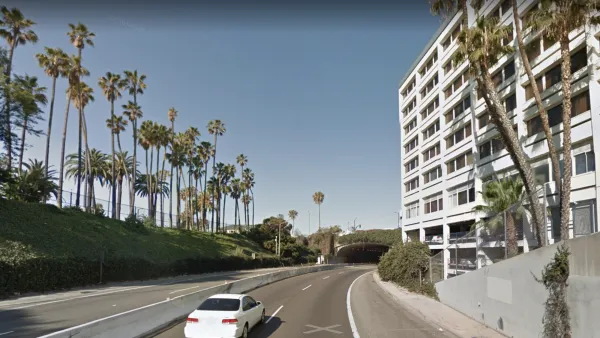
Santa Monica to Plan for a Freeway Cap Where the I-10 Meets the Pacific Coast
The terminus of the I-10 freeway is a 7,000-foot concrete trench across the heart of Santa Monica. The city's new downtown plan calls for a cap, and a new master plan will hammer out specifics.
Santa Monica Mayor: High Inclusionary Housing is Worth the Risk
Mayor Ted Winterer and Mayor Pro Tem Gleam Davis elaborate on the city’s new Downtown Community Plan, which includes what may be the state's highest inclusionary housing requirement.

Critiquing Santa Monica's 'Grand Bargain' of a Downtown Plan
The city of Santa Monica increased in population by 6,500 between 1960 and 2010, while the rest of Los Angeles County grew by 60 percent over the same period. A debate over a new downtown plan that includes more housing was never going to be simple.

Planetizen Federal Action Tracker
A weekly monitor of how Trump’s orders and actions are impacting planners and planning in America.

Eastern Nebraska is running out of electricity
Data centers and electrification are straining eastern Nebraska’s grid, throttling economic development.

Washington state to charge fee to drivers with fuel-efficient cars
Revenue from the fee will go towards supporting the state’s highways.

Instead of building new housing, LA developers are turning mansions into mega-mansions
In the richest areas, the number of houses valued at $30 million with demolition permits has skyrocketed since 2018.

Illinois considers spending $1 billion in taxpayer money on data center
A quantum computing campus and data center are currently under construction in Chicago.

As development costs rise, Boston moves to lessen affordable housing requirements
The Boston Zoning Commission and the City Council still need to approve Boston Mayor Michelle Wu’s proposed changes

FREE Course: Walkable City 1: Why Walkability?
After describing his path towards focusing on walkability as the essence of good planning, Jeff Speck marches through his five principal reasons for making more walkable places.
Reinventing Malls: Planning Alchemy—Turning Gray Fields Into Gold
The course focuses on the opportunities and imperatives that shape reinvention of mall sites.

City of Charlotte
City of Rosemead
Rutgers University, Edward J. Bloustein School of Planning and Public Policy
University of Michigan School for Environment and Sustainability (SEAS)
Hunter College, City University of New York (CUNY)
The Architects Foundation
City of Cambridge
The Pocatello Development Authority
The Urban Renewal Agency of the City of Pocatello