Most utilities in the United States have committed to protecting the supply of water for people struggling to pay the bills during the coronavirus.



"Millions of Americans risk losing running water if they fall behind with bill payments in coming months, as mass layoffs triggered by the coronavirus pandemic force families to make impossible tradeoffs on paying household expenses," writes Nina Lakhani.
Data analyzed by Food and Water Watch (FWW) and the Guardian estimates that two-fifths of the country relies on water from utilities that haven't suspended water shut-offs as the country reels from the effects of the coronavirus pandemic—also despite the hygienic necessity of water to combat the spread.
"Yet despite the evolving economic and health crises, less than 60% of the population have so far been protected from water shutoffs," writes Lakhani. "And just 11% of these utilities have explicitly pledged to reconnect households currently without running water due to unpaid bills."
According to the data, the parts of the country most vulnerable to the effects of the public health crisis are more likely to lack protections from utilities—states like Louisiana, Arkansas, Florida, and Oklahoma. By comparison, 12 states—California, Indiana, Kentucky, Maine, Maryland, Michigan, Montana, New Hampshire, New Jersey, North Carolina, Ohio, and Wisconsin—have issued moratoriums on water shut offs.
Read the full story: Millions in US at risk of 'water shutoffs' amid layoffs triggered by pandemic

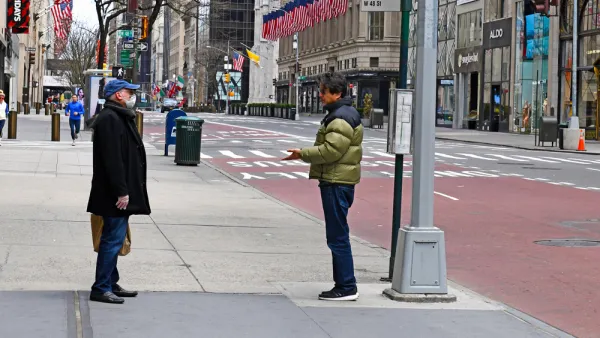
Friday Eye Candy: Covid-19, Then and Now
The New York Times compared images from readers portraying similar scenes in 2020 and 2022.
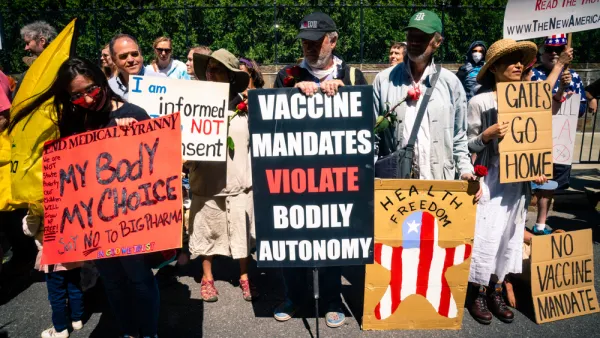
The Shifting Demographics of Covid-19
For most of the Covid-19 pandemic, Black Americans died at much higher rates than White Americans. That trend has reversed at times during the past year.

Acceptable Deaths
What can we learn from our Covid response?

Planetizen Federal Action Tracker
A weekly monitor of how Trump’s orders and actions are impacting planners and planning in America.

Colorado’s Largest Data Center Could Rise Next to Homes — Without a Public Hearing
The proposed campus would consume 11 times the power of Denver International Airport; as it has across the country, opposition mounts.

US to reduce Colorado River water deliveries to Mexico
A new Colorado Treaty amendment reduces Mexico’s Colorado River water allocation by 250,000 acre feet.

'This is going to be painful:’ Virginia stares down $1.7 billion funding gap for highway maintenance
The state may address the deficit by shifting $290 million from its construction budget to maintenance projects.

Judges permit Denver to divert 77,000 acre feet from the Colorado River for reservoir expansion
Overuse and climate change have caused the Colorado River’s water levels to plummet.

Amtrak, CN end decades-long dispute with eight-year agreement
The new operating agreement establishes an updated framework for the companies to work together, including processes to resolve disputes.

FREE Course: Walkable City 1: Why Walkability?
After describing his path towards focusing on walkability as the essence of good planning, Jeff Speck marches through his five principal reasons for making more walkable places.
Reinventing Malls: Planning Alchemy—Turning Gray Fields Into Gold
The course focuses on the opportunities and imperatives that shape reinvention of mall sites.

KFH Group Inc.
Greater Baltimore Committee
Eagle County Government
The Architects Foundation
University of Cincinnati Online
The Pocatello Development Authority
The Urban Renewal Agency of the City of Pocatello