Planning and building the future will have to wait.


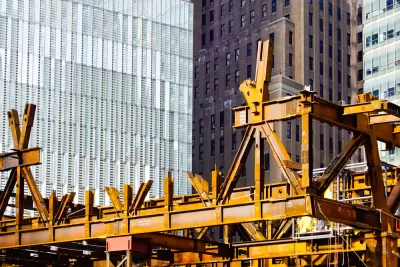
From a March 16, 2020 press release on the New York City Department of City Planning website:
“To avoid the need to hold public gatherings and minimize the potential spread of COVID-19, Mayor Bill de Blasio has temporarily suspended New York City’s land use decision making processes. The suspension of the City's official public review process, the Uniform Land Use Review Procedure (ULURP), was made via Executive Order.
As of the issuance of this Executive Order, all City Planning Commission meetings, including public hearings and votes required as part of land use review processes, are suspended and the time periods for hearings and votes will not run.”
The press release only promises an announcement of when the land use review process will resume in the city, but does not offer a projected timeline.
Meanwhile in Boston on the same day, Tim Logan reports that Mayor Marty J. Walsh "ordered a stop to all construction projects in the city, citing concerns about worker safety and a need to blunt the spread of the highly contagious virus." The move brings the city's ongoing building boom to a halt, according to Logan.
"The move will bring billions of dollars of construction work to an abrupt halt, leaving the prospect of half-finished office towers and apartment buildings all over town, at least for the time being," writes Logan. Still unclear: where the economic pain of the shutdown will be felt most acutely: "A web of investors, developers, large general contractors, and smaller subcontractors all have money on the line in a major project, and often promise firm delivery dates to potential tenants. The longer the shutdown, the more those costs will grow."
Read the full story: Statement from Department of City Planning Director and City Planning Commission Chair Marisa Lago

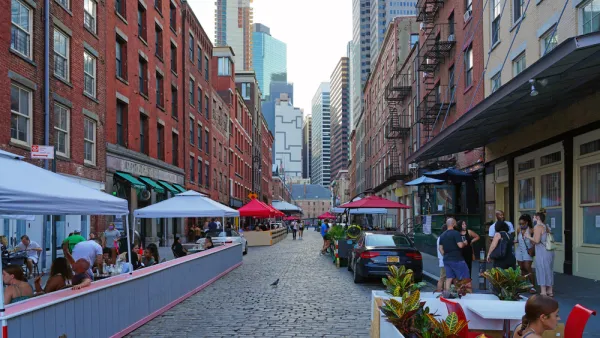
New York Outdoor Dining, Open Streets Programs Now Permanent
New York City will now be measurably less car-centric for the indefinite future.
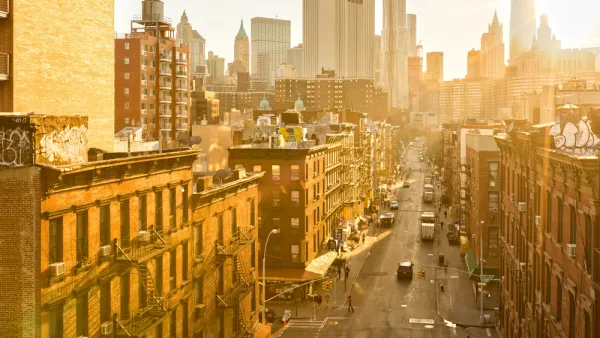
Opinion: Upzone Now to Improve Commutes in the Post-Lockdown Future
Building more housing where people work is a simple way to come out of the pandemic with a stronger sense of community and shorter commutes, according to this article.

Bike Share Lessons From the Pandemic
Bike share data from six U.S. cities offer insight into how Americans have changed travel patterns during the pandemic.

Planetizen Federal Action Tracker
A weekly monitor of how Trump’s orders and actions are impacting planners and planning in America.

California plans to bury El Niño’s downpour
If the state plays its cards right, it may be able to store a billion acre-feet of El Niño’s water in aquifers.

Chicago breaks ground on $3 billion megadevelopment
The new neighborhood, titled Foundry Park, will one day host 3,700 residences.

Satanic Place Names
From streams and lakes to valleys and canyons, I mapped more than 1,000 places named after the Devil.

California High-Speed Rail Authority CEO resigns after $600,000 scandal
Under Ian Choudri, the authority used taxpayer dollars to fund first class flights and trips to nightclubs.

Want to study the Missouri River? Soon, you may need unanimous approval from 10 states
Legislation would require 10 governors’ permission to study or build projects moving water outside the basin.

FREE Course: Walkable City 1: Why Walkability?
After describing his path towards focusing on walkability as the essence of good planning, Jeff Speck marches through his five principal reasons for making more walkable places.
Reinventing Malls: Planning Alchemy—Turning Gray Fields Into Gold
The course focuses on the opportunities and imperatives that shape reinvention of mall sites.

City of Rosemead
Rutgers University, Edward J. Bloustein School of Planning and Public Policy
One Hundred Miles
Hunter College, City University of New York (CUNY)
The Architects Foundation
University of Cincinnati Online
City of Cambridge
Montrose County
The Pocatello Development Authority