The traditional narratives about the history of planning fail to note the role of Black urbanists, as well as the effect of planning policies on Black Americans.



Inspired by recent attendance at the Black in Design Conference, Daphne Lundi writes about how the work of Black urbanists is "inexplicably and inexcusably absent from the planning canon."
After noting that Black history and experience is "deeply interwoven with urban planning praxis," through policies like redlining, suburbanization, and transportation planning, Lundi issues a call to action to planners:
As planners, we help shape the built environment — and not just through our plans. Without a full understanding of the history of a place and our profession, we run the risk of reproducing systems and methods that further deepen inequality. A planning education that focuses solely on a few predominantly white heroic figures is incomplete and unethical. It doesn't tell the whole story; it prevents us from sharing fuller and richer stories. We must learn to think beyond our traditional planning narratives.
The Black in Design Conference is a biennial event organized by the Harvard University Graduate School of Design's African American Student Union. As Lundi notes, the Black in Design Conference is part of a growing number of organizations are "shining light on Black urbanism and Black experiences in the built environment."
Read the full story: Rewriting the Urban Planning Canon

Repositioning Black Urbanists in the History of Planning
The history of planning is dominated by a few iconic figures—all white.
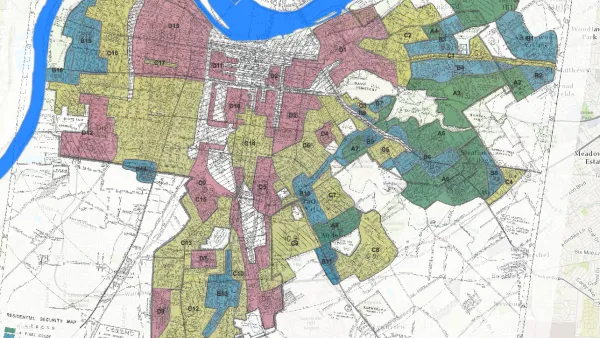
Story Mapping the Racism in Planning History
A Story Map created by the Louisville Metro Office of Planning & Design Services offers a detailed, visual presentation of the history of racism and discriminatory in the planning and zoning of the Louisville and Jefferson County.

History (Un)made: Berkeley City Council Votes to Eliminate Single-Family Zoning
The city that invented single-family zoning in 1916, for discriminatory purposes, will completely remove that exclusionary legacy from its zoning code.

Planetizen Federal Action Tracker
A weekly monitor of how Trump’s orders and actions are impacting planners and planning in America.

Eastern Nebraska is running out of electricity
Data centers and electrification are straining eastern Nebraska’s grid, throttling economic development.

Washington state to charge fee to drivers with fuel-efficient cars
Revenue from the fee will go towards supporting the state’s highways.

Instead of building new housing, LA developers are turning mansions into mega-mansions
In the richest areas, the number of houses valued at $30 million with demolition permits has skyrocketed since 2018.

Illinois considers spending $1 billion in taxpayer money on data center
A quantum computing campus and data center are currently under construction in Chicago.

As development costs rise, Boston moves to lessen affordable housing requirements
The Boston Zoning Commission and the City Council still need to approve Boston Mayor Michelle Wu’s proposed changes

FREE Course: Walkable City 1: Why Walkability?
After describing his path towards focusing on walkability as the essence of good planning, Jeff Speck marches through his five principal reasons for making more walkable places.
Reinventing Malls: Planning Alchemy—Turning Gray Fields Into Gold
The course focuses on the opportunities and imperatives that shape reinvention of mall sites.

City of Charlotte
City of Rosemead
Rutgers University, Edward J. Bloustein School of Planning and Public Policy
University of Michigan School for Environment and Sustainability (SEAS)
Hunter College, City University of New York (CUNY)
The Architects Foundation
University District Partnership
City of Cambridge
The Pocatello Development Authority