Denver and Los Angeles kicked the new year off by committing to the enforcement of a sleeping ban and sweeping away a large homeless encampment, respectively.


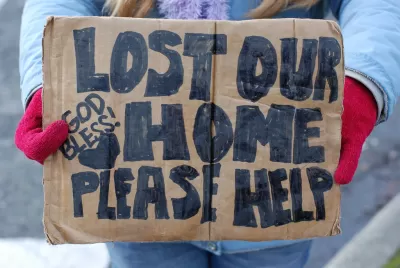
"Denver police will resume their enforcement of the city’s controversial urban camping ban — likely by the end of the week — after a more than two-week hiatus," reports Conrad Swanson.
Denver City Attorney Kristin Bronson is committing to the enforcement of the ban approved by the City Council in 2012, despite a county court dismissing a ticket issued to a homeless man for violating the law. "While the ruling said the ban amounts to cruel and unusual punishment, it did not strike down the law or prohibit the city from enforcing it," explains Swanson of Bronson's take on the ruling.
According to Swanson, the Denver City Council approve the law specifically to respond to Boise v. Martin, but the court ruling cited that case in tossing the ticket issued by the city.
"So the Denver camping ban included language that ensured people are offered shelter before police ticket or arrest them, Bronson said, and since then the ordinance has been enforced judiciously and compassionately," writes Swanson.
Meanwhile in Los Angeles: "The final phase of a cleanup of homeless encampments in the Sepulveda Basin Recreation Area began early Wednesday morning," report Elizabeth Chou and Ariella Plachta. The clean up is expected to continue for several weeks, after months of previous work to clean up other nearby camps.
"Wednesday’s cleanup effort targets a floodplain near Encino Creek, an area people are legally not supposed to enter because of dangers posed during heavy rain," according to the article. "The area floods when Army Corps of Engineers operators close the Sepulveda Dam." The article includes on the ground accounts of the homeless people living in the area and displaced by the clean up.
Read the full story: Police will resume enforcing Denver camping ban, city attorney says

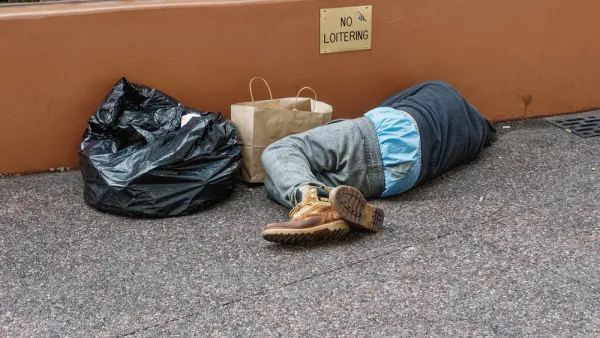
Las Vegas Approves Homeless Camping Ban
The city of Las Vegas has approved a law that prohibits the homeless from camping in large swaths of the city. The measure provoked the opposition on most of the public in attendance at a City Council hearing this week.

Will Appeal of Landmark Appeals Court Ruling Allow for Clearing of Tent Cities?
If the Supreme Court hears an appeal of a landmark U.S. Ninth Circuit Court case settled in April, the ruling would have widespread implications for dealing with homeless encampments throughout the West, perhaps nowhere more so than Los Angeles.
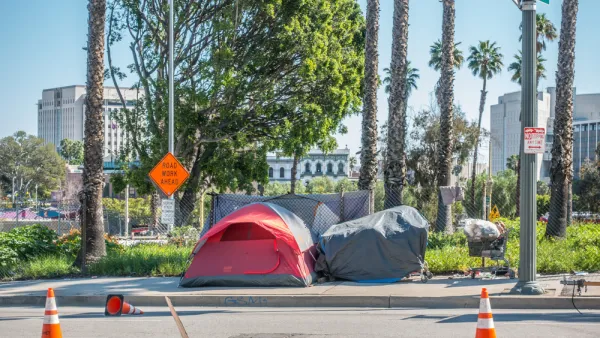
Los Angeles Could Broaden Homeless Sleeping Prohibition to a Quarter of the City
There won't be many places left to sleep for the massive population of homeless living in the city of Los Angeles.

Planetizen Federal Action Tracker
A weekly monitor of how Trump’s orders and actions are impacting planners and planning in America.

California plans to bury El Niño’s downpour
If the state plays its cards right, it may be able to store a billion acre-feet of El Niño’s water in aquifers.

Chicago breaks ground on $3 billion megadevelopment
The new neighborhood, titled Foundry Park, will one day host 3,700 residences.

California High-Speed Rail Authority CEO resigns after $600,000 scandal
Under Ian Choudri, the authority used taxpayer dollars to fund first class flights and trips to nightclubs.

Want to study the Missouri River? Soon, you may need unanimous approval from 10 states
Legislation would require 10 governors’ permission to study or build projects moving water outside the basin.

Desperate measures: Advocates weigh draining Lake Powell to fill Colorado River
Draining the reservoir could reduce evaporation losses by a couple hundred thousand acre-feet.

FREE Course: Walkable City 1: Why Walkability?
After describing his path towards focusing on walkability as the essence of good planning, Jeff Speck marches through his five principal reasons for making more walkable places.
Reinventing Malls: Planning Alchemy—Turning Gray Fields Into Gold
The course focuses on the opportunities and imperatives that shape reinvention of mall sites.

City of Rosemead
Rutgers University, Edward J. Bloustein School of Planning and Public Policy
One Hundred Miles
Hunter College, City University of New York (CUNY)
The Architects Foundation
University of Cincinnati Online
City of Cambridge
Montrose County
The Pocatello Development Authority