Food cart vendors are fighting for their livelihood in a neighborhood in Philadelphia, against the long legislative reach of a local developer.


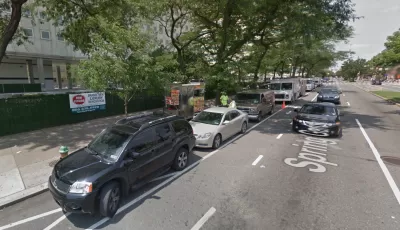
Jake Blumgart reports on the evolving legislative position of the city of Philadelphia on the matter of food carts in the city.
The story starts with the example provided by a collection of food cart vendors formerly located at a prime position near the Spring Garden Broad Street Line stop and on the same side of the street as the Community College of Philadelphia.
During construction of a new development by Bart Blatstein ("a one-story retail complex anchored by a CVS, right next to his Tower Place apartment building"), the food cart businesses were relocated to a much less prime position in the neighborhood and business has plummeted.
"The luxury apartments brought hundreds of new residents and the new shopping brought even more street traffic — growth that could help neighborhood entrepreneurs like [food vendor Mike] Debesai. But in the case of the food vendors, the new development has generated the opposite impact," according to Blumgart.
But that is only the beginning of this story. During construction, the City Council approved legislation, proposed by City Council President Darrell Clarke, to ban street vendors on Spring Garden between Broad and 16th streets. Since the Blatstein project opened, the food vendors haven't been able to return to their previous, more lucrative spot. The food cart vendors report feeling powerless to respond to the business interests of large developers.
Read the full story: Food cart owners say City Hall is pushing them out of Philly. Here’s why.

D.C. Passes New Street Vending Rules
The District’s new regulations lower permit fees, reduce barriers to entry for vendors, and decriminalize vending offenses.
Decatur Approves New Food Cart Program
Mobile food vendors can now apply for permits to operate in several of the city’s public spaces.
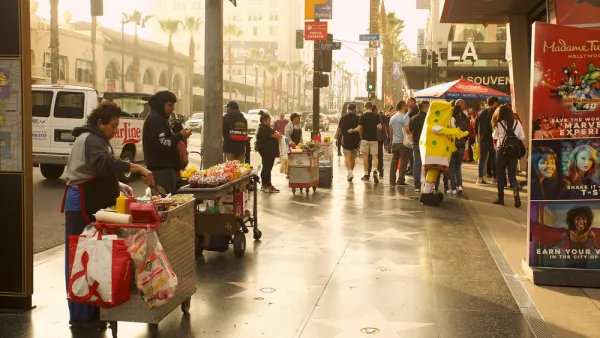
Legalizing Street Vending: Lessons from Los Angeles
With new regulations poised to add 400 new vendors to New York City's streets every year for the next decade, city leaders can look to L.A.'s recent legalization efforts for guidance.

Planetizen Federal Action Tracker
A weekly monitor of how Trump’s orders and actions are impacting planners and planning in America.

California plans to bury El Niño’s downpour
If the state plays its cards right, it may be able to store a billion acre-feet of El Niño’s water in aquifers.

Desperate measures: Advocates weigh draining Lake Powell to fill Colorado River
Draining the reservoir could reduce evaporation losses by a couple hundred thousand acre-feet.

US buildings threatened, destroyed by fires set to triple by 2060
Researchers found a high fire risk for socioeconomically vulnerable neighborhoods in the American West.

LA residents may be allowed to paint their own crosswalks
Councilwoman Katy Yaroslavsky put out a motion instructing the Los Angeles Department of Public Transportation to study the feasibility of allowing volunteers to paint crosswalks.

Dallas moves to overhaul its zoning code
The city's zoning reform will allow more multi-family and mixed-use developments.

FREE Course: Walkable City 1: Why Walkability?
After describing his path towards focusing on walkability as the essence of good planning, Jeff Speck marches through his five principal reasons for making more walkable places.
Reinventing Malls: Planning Alchemy—Turning Gray Fields Into Gold
The course focuses on the opportunities and imperatives that shape reinvention of mall sites.

City of Rosemead
Rutgers University, Edward J. Bloustein School of Planning and Public Policy
One Hundred Miles
Hunter College, City University of New York (CUNY)
The Architects Foundation
University of Cincinnati Online
City of Cambridge
Montrose County
The Pocatello Development Authority