In a new policy brief and a series of working papers, housing experts consider the future of the Community Reinvestment Act, the federal law enacted in 1977 to combat redlining and discrimination in mortgage markets.


In February 2019, the Federal Reserve Board, Federal Reserve Bank of Philadelphia, and Penn IUR jointly convened a research symposium to consider the future of the Community Reinvestment Act (CRA), a federal law enacted in 1977 to combat redlining and discrimination in mortgage markets. Nearly 100 stakeholders—including Federal Reserve Board governors and policymakers, regulators and rule writers, academics and researchers, community development leaders and policy practitioners—came together at the Federal Reserve Bank of Philadelphia to discuss the past, present, and future of the Community Reinvestment Act (CRA). The conference was especially timely given the recent call by Office of the Comptroller of the Currency (OCC) for comments on how to modernize the CRA. The one-day conference focused on using data-driven approaches to evaluate the effectiveness of the CRA in its current form, lending an evidence-based lens to forecast how to best modify the CRA going forward. Two issues predominated: how to modernize the CRA’s local bank branch-centric framework in an age of internet banking and how to respond to the new challenge of access to affordable housing in resurgent urban areas.
In this policy brief, entitled “The Future of the Community Reinvestment Act,” we provide background on the issues and summarize the discussion and research findings presented at the symposium. The resulting papers from the conference are now available as working papers on the Federal Reserve Bank of Philadelphia and Penn IUR websites (see links below). They will be published as a special volume of Housing Policy Debate, co-edited by Lei Ding and Susan Wachter, that addresses issues surrounding the modernization of the CRA.
- Research Symposium on the Community Reinvestment Act: Introduction | Susan Wachter and Lei Ding
- Who Lends Beyond the Red Line? The Community Reinvestment Act and the Legacy of Redlining | Kevin A. Park and Roberto G. Quercia
- The Community Reinvestment Act and Bank Branching Patterns | Lei Ding and Carolina Reid
- Is the CRA Still Relevant to Mortgage Lending? | Paul Calem, Lauren Lambie-Hanson, and Susan Wachter
- The Community Reinvestment Act: What Do We Know, and What Do We Need to Know?| Laurie Goodman, Jun Zhu, and John Walsh
- The Community Reinvestment Act at 40: Why Is It Still Necessary to “Lean” on Banks? | Lawrence J. White
- Quantitative Performance Metrics for CRA: How Much “Reinvestment” is Enough? | Carolina Reid
- Updating CRA Geography: It’s Not Just About Assessment Areas | Mark Willis
- Concluding Observations on CRA Reform | Michael Barr
FULL STORY: The Future of the Community Reinvestment Act


Singapore Housing Lessons for the Biden Administration
Singapore's carefully designed public housing that supports mixed-incomes, green space, and access to high-quality transportation is a good benchmark for the Biden administration's new push to root out systemic racism in the housing market.

Can Reparations Right the Wrongs Caused by a Highway?
An elevated highway destroyed an African American community in Syracuse, New York. Is just removing it enough?
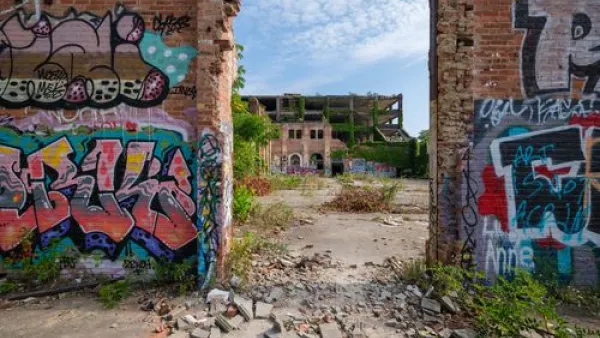
Cleveland is turning abandoned real estate into ‘housing innovation district,’ jobs
The city’s housing innovation district will bring pro-housing policies to disinvested neighborhoods.

Planetizen Federal Action Tracker
A weekly monitor of how Trump’s orders and actions are impacting planners and planning in America.

The state-sanctioned urbicide of Austin
People don’t kill cities. Freeways do.

US to reduce Colorado River water deliveries to Mexico
A new Colorado Treaty amendment reduces Mexico’s Colorado River water allocation by 250,000 acre feet.

Mamdani overhauls NYC's Vision Zero plan with 100 new policy goals
The overhaul aims to reduce traffic deaths and make streets safer for pedestrians, cyclists and drivers through lower speed limits, new safety infrastructure and more.

Amtrak not solely to blame for New Jersey commuter rail's unreliability, report finds
A new study from the Garden State Initiative found that NJ Transit’s budget grew 20% across a 4 year period, but reliability declined significantly over the same period.

EPA erases limits on planet-warming pollution from power plants
Under Monday’s plan, power plants would still have some limits on how much mercury, arsenic and other contaminants they can emit.

FREE Course: Walkable City 1: Why Walkability?
After describing his path towards focusing on walkability as the essence of good planning, Jeff Speck marches through his five principal reasons for making more walkable places.
Reinventing Malls: Planning Alchemy—Turning Gray Fields Into Gold
The course focuses on the opportunities and imperatives that shape reinvention of mall sites.

Eagle County Government
Harvard University Graduate School of Design
Nashville Planning Department
The Architects Foundation
University of Cincinnati Online
The Pocatello Development Authority
The Urban Renewal Agency of the City of Pocatello
Journal of the American Planning Association