Google's plans for the Diridon Transit Village are much more clear.


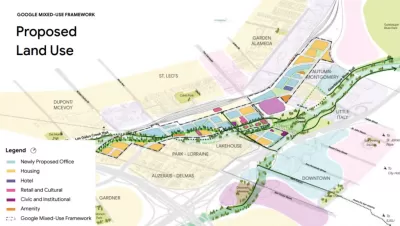
Google recently revealed its plans for the Diridon Transit Village in San Jose, California.
Keren Dillard reports:
In a San Jose, California, community meeting on August 22, Google revealed its plans for the San Jose Transit Village. The mile-long village along the former industrial area west of Highway 87 is anticipated to house 5.5 million square feet of office space for the tech company, 3,000 to 5,000 housing units, a combined 500,000 square feet of space for retail, culture, and education, and 15 acres of green spaces. The proposed plan holds the potential to provide employment for 20,000 to 25,000 people.
The goal of the plan is to create an urban hub designed for humans, rather than cars, according to Dillard. Diridon Station, already a bustling transit station with BART service on the way in the future, serves as the centerpiece of the mobility options and scale of the Framework Plan.
Google worked with SITELAB Urban Studio to create the Framework Plan for the transit village and with Trammel Crow to acquire the land necessary to complete the vision described in the Framework Plan.
Original reporting of the Framework Plan is available from the Mercury News.
FULL STORY: Google reveals the future of its San Jose Transit Village

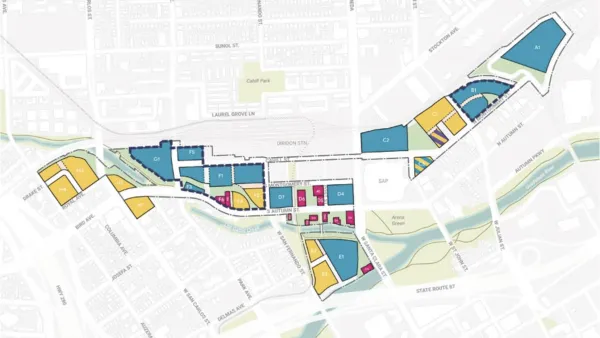
Google's Big Mixed-Use Plans for Downtown San Jose Come Into Focus
Google's plan for a mixed-use transit village at a mile-long site near the Diridon Station in San Jose has a newly released planning document available for public review.
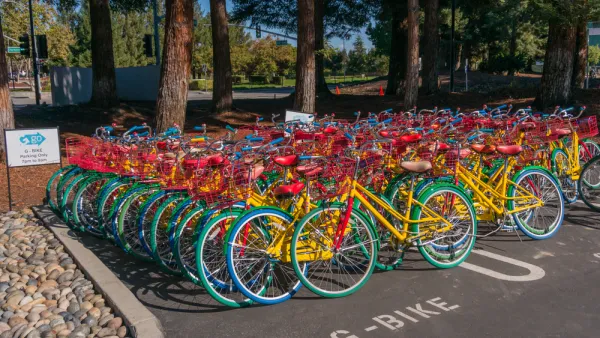
Google Expanding its Presence in San Jose
Google has expanded its footprint in North San Jose to cover 1.27 million square feet. Local officials are saying that the company's acquisitions ensure the long-term financial stability of the city.
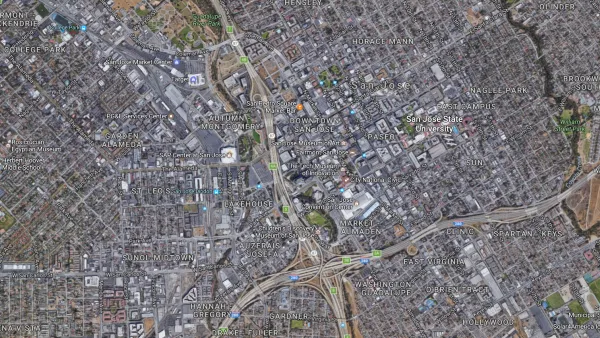
San Jose Wants 25 Percent Affordable Housing With Big Google Development
The city of San Jose is pushing Google to mitigate the effects of gentrification and displacement at its planned transit oriented facility in downtown San Jose.

Planetizen Federal Action Tracker
A weekly monitor of how Trump’s orders and actions are impacting planners and planning in America.

The state-sanctioned urbicide of Austin
People don’t kill cities. Freeways do.

US to reduce Colorado River water deliveries to Mexico
A new Colorado Treaty amendment reduces Mexico’s Colorado River water allocation by 250,000 acre feet.

5 New England states march closer to 800 megawatt wind energy project
Securing federal approval for the project may be complicated under the Trump administration, which has historically been hostile towards domestic wind power.

Baltimore to break ground on $50 million Transit Priority Project
The project will bring faster bus trips, safer streets and better bike connections to Baltimore.

Airbnb launches $250 million 'last-dollar financing' housing accelerator, makes first investment in Austin
The company will put $6.4 million towards affordable housing development in Texas’ capital.

FREE Course: Walkable City 1: Why Walkability?
After describing his path towards focusing on walkability as the essence of good planning, Jeff Speck marches through his five principal reasons for making more walkable places.
Reinventing Malls: Planning Alchemy—Turning Gray Fields Into Gold
The course focuses on the opportunities and imperatives that shape reinvention of mall sites.

Eagle County Government
Harvard University Graduate School of Design
Nashville Planning Department
The Architects Foundation
University of Cincinnati Online
The Pocatello Development Authority
The Urban Renewal Agency of the City of Pocatello
Journal of the American Planning Association