Primarily serving commuters in the Greater Los Angeles metro area, Metrolink just attained the highest annual ridership in its 27-year existence. Officials chalk up the increase to a significant investment in marketing.


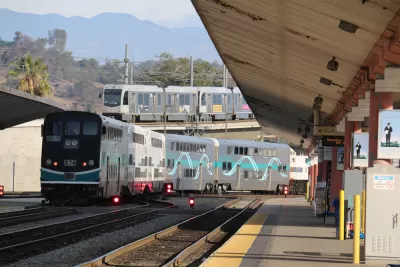
"One Southern California transit agency seems to be bucking the trend of nationwide ridership declines," writes Steven Sharp. That agency is Metrolink, which recently announced that its ridership stands at a historic high: nearly 12 million boardings in the 2018-2019 fiscal year.
"Metrolink officials attributed the [...] increase from 2017-2018 - the fifth straight year of ridership increases - to increased marketing, an improved economy, and discounted fares on some lines, and free trials for Earth Day and Bike Month," Sharp writes.
To further the upward trend, Metrolink has proposed major improvements to its system, including "partial electrification and the addition of new stations, grade separations, and segments of double- and triple-track." The system's goal is to double its current ridership of 40,000 weekday boardings by 2023.
FULL STORY: Metrolink Logs Record Ridership in 2018-2019

Southern California's Declining Transit Ridership, Explained
More Southern Californians are purchasing motor vehicles, particularly those who were previously transit-dependent, which largely explains the region's declining transit ridership, according to a newly released study.

Storms Sever California Rail Line—Again
The coast-hugging rail corridor linking Los Angeles and San Diego faces an uncertain future as mudslides once again force part of the line to close.

L.A. County City Calls for New BRT Line
Pico Rivera has released an ambitious plan that would create more transit connections in eastern Los Angeles County.

Planetizen Federal Action Tracker
A weekly monitor of how Trump’s orders and actions are impacting planners and planning in America.

The state-sanctioned urbicide of Austin
People don’t kill cities. Freeways do.

US to reduce Colorado River water deliveries to Mexico
A new Colorado Treaty amendment reduces Mexico’s Colorado River water allocation by 250,000 acre feet.

5 New England states march closer to 800 megawatt wind energy project
Securing federal approval for the project may be complicated under the Trump administration, which has historically been hostile towards domestic wind power.

Baltimore to break ground on $50 million Transit Priority Project
The project will bring faster bus trips, safer streets and better bike connections to Baltimore.

Airbnb launches $250 million 'last-dollar financing' housing accelerator, makes first investment in Austin
The company will put $6.4 million towards affordable housing development in Texas’ capital.

FREE Course: Walkable City 1: Why Walkability?
After describing his path towards focusing on walkability as the essence of good planning, Jeff Speck marches through his five principal reasons for making more walkable places.
Reinventing Malls: Planning Alchemy—Turning Gray Fields Into Gold
The course focuses on the opportunities and imperatives that shape reinvention of mall sites.

Eagle County Government
Harvard University Graduate School of Design
Nashville Planning Department
The Architects Foundation
University of Cincinnati Online
The Pocatello Development Authority
The Urban Renewal Agency of the City of Pocatello
Journal of the American Planning Association