With big cuts coming to Capital Area Transit bus service in Cumberland County, Pennsylvania, businesses are looking for new ways to get workers to their jobs.


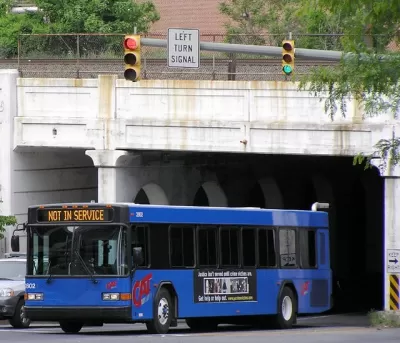
Cumberland County, Pennsylvania is facing the prospect of reduced bus service. "The county is served by Capital Area Transit (CAT), which is facing a 24% reduction in service. A consultant is being brought on to undertake a massive overhaul of CAT’s bus routes and system," Bennett Leckrone reports for The Patriot-News.
The changes at CAT expand beyond the service reductions. CAT just finished updating its payment system, and the agency has plans to update their website and mobile app. All that work must be accomplished on a constrained budget. CAT officials hope a redesign will realize some efficiencies, and reduce deadheading (i.e., non revenue bus travel time) to cut cost. Even with those benefits, officials are predicting some loss of service. The CAT may raise fares, but this would not be likely to provide a total solution to the budget issue, as fares only cover part of the costs of the service.
Businesses in the CAT service area have voiced concerns about the impacts of the reductions on the workforce, many of whom depend on CAT to commute. "Crystal A. Quintin, a regional director at the Geisinger Health Foundation, said it’s not just the employees that need to get to a business, but the customers as well," Leckrone reports. Less convenient transit can lead to suppressed demand meaning that some will simply not travel to the service if transit is not convenient or affordable, and fewer trips could mean fewer customers.
Read the full story: CAT bus service cuts mean businesses are looking for other ways to get employees to work

Suburban Detroit Achieves Long-Awaited Bus Service Expansion
Novi and Bloomfield Hills in Southeast Michigan will have transit service for the first time in 28 years.

The Bus Revolution Has Been Revised in Philadelphia
The Southeastern Pennsylvania Transportation Authority went back to the drawing board with its Bus Revolution system redesign after an initial round of feedback completed earlier this year.
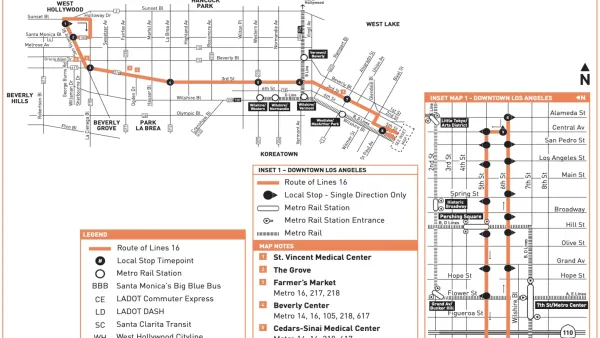
Popular L.A. Bus Line to Replace Schedule With ‘Headway-Based Operations’
Los Angeles’ 16 bus, which cuts across the city on Third Street through some of the city’s densest neighborhoods, will experiment with a new approach to service design.

Planetizen Federal Action Tracker
A weekly monitor of how Trump’s orders and actions are impacting planners and planning in America.

California plans to bury El Niño’s downpour
If the state plays its cards right, it may be able to store a billion acre-feet of El Niño’s water in aquifers.

Desperate measures: Advocates weigh draining Lake Powell to fill Colorado River
Draining the reservoir could reduce evaporation losses by a couple hundred thousand acre-feet.

Chicago voters approve permanent festival grounds, penalty for vacant property owners
Currently, major summer and fall festivals take over public parks for weeks at a time, drawing criticism from nearby residents

NYC votes to cut outdoor dining red tape, speed up permitting
New York City also voted to allow the Department of Transportation to begin work on urgent projects before notifying elected officials.

California appears to reject Prop. 45
The proposition would have expanded the projects that qualify for a streamlined environmental review, effectively paring down the California Environmental Quality Act.

FREE Course: Walkable City 1: Why Walkability?
After describing his path towards focusing on walkability as the essence of good planning, Jeff Speck marches through his five principal reasons for making more walkable places.
Reinventing Malls: Planning Alchemy—Turning Gray Fields Into Gold
The course focuses on the opportunities and imperatives that shape reinvention of mall sites.

City of Rosemead
Rutgers University, Edward J. Bloustein School of Planning and Public Policy
One Hundred Miles
Hunter College, City University of New York (CUNY)
The Architects Foundation
University of Cincinnati Online
City of Cambridge
Montrose County
The Pocatello Development Authority