A new book looks at the evolution of American ballparks and the changes that have mirrored urbanism.


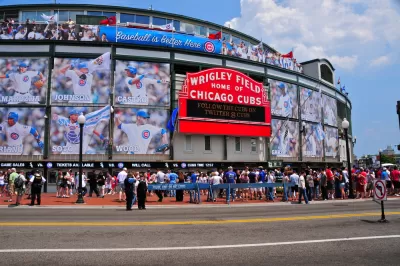
Ballpark: Baseball in the American City is a new book from Paul Goldberger that traces the history of ballparks in the United States. "From the utilitarian beauty of early 20th-century ballparks like Chicago’s Wrigley Field and Boston’s Fenway Park—each nestled into its respective neighborhood—to the doughnut-shaped, concrete structures that sprouted in suburbia after World War II, baseball’s growth has neatly paralleled the rise, fall, and rise again of U.S. cities," says Patrick Sisson.
The first ballparks sprung up in cities, and they were very enmeshed in the urban landscape. In postwar America, they moved to the suburbs, writes Sisson. "This was the time of the 'concrete doughnuts,' which Goldberger argues were bland, multipurpose, municipal parks often set far from the city center, ones like Oakland Coliseum, Fulton County Stadium in Atlanta, and Philadelphia’s Veterans Stadium."
Ballparks then returned to the city, along with urban renewal. The most recent era, according to Goldberger, is one where ballparks are part of commercial and entertainment megadevelopments. "With Atlanta’s new park, as well as recent developments around the St. Louis ballpark and Chicago’s Wrigley Field—where the surrounding Wrigleyville neighborhood is gradually being turned into a more generic, mall-like destination—Goldberger is disappointed to see team owners trying to control the city inside and outside of the gate," notes Sisson.
FULL STORY: Looking at the changing American city through its ballparks

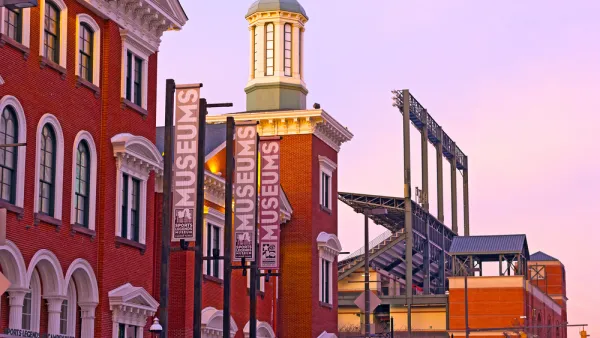
Take Me Out to the City
Architecture critic Paul Goldberger analyzes the evolution of baseball stadiums and celebrates their essential connection to cities in "Ballpark: Baseball in the American City."
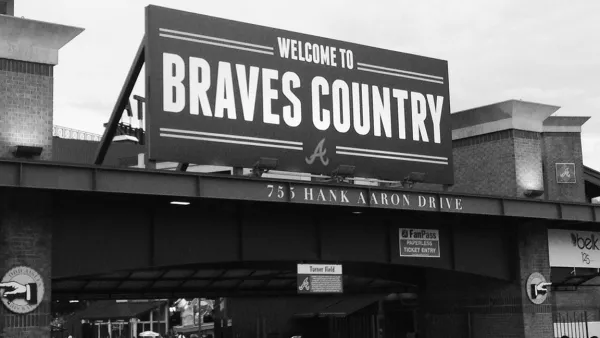
On the Land Use and Transit Implications of 'Take Me Out to the Ballgame'
The decision of where to locate ballparks, and to what extent the public should subsidize that location, can have ripple effects throughout the land use and transportation systems of a region.
Midburbs: A New Definition of Suburbs
When the name “suburb” just doesn't quite fit.

The state-sanctioned urbicide of Austin
People don’t kill cities. Freeways do.

US to reduce Colorado River water deliveries to Mexico
A new Colorado Treaty amendment reduces Mexico’s Colorado River water allocation by 250,000 acre feet.

New Jersey’s second-largest city bans standalone data centers
Jersey City will continue to allow co-location facilities, such as those meant for research institutions that store their own data.

Amtrak not solely to blame for New Jersey commuter rail's unreliability, report finds
A new study from the Garden State Initiative found that NJ Transit’s budget grew 20% across a 4 year period, but reliability declined significantly over the same period.

EPA erases limits on planet-warming pollution from power plants
Under Monday’s plan, power plants would still have some limits on how much mercury, arsenic and other contaminants they can emit.

Phoenix announces new on-demand transit service, more frequent RAPID buses
Both new services will launch in October, and are part of Phoenix's Project Effective Access Solutions for Easing Congestion.

FREE Course: Walkable City 1: Why Walkability?
After describing his path towards focusing on walkability as the essence of good planning, Jeff Speck marches through his five principal reasons for making more walkable places.
Reinventing Malls: Planning Alchemy—Turning Gray Fields Into Gold
The course focuses on the opportunities and imperatives that shape reinvention of mall sites.

Eagle County Government
Harvard University Graduate School of Design
Nashville Planning Department
The Architects Foundation
University of Cincinnati Online
The Pocatello Development Authority
The Urban Renewal Agency of the City of Pocatello
Journal of the American Planning Association