Officials hope that improving access to housing for people who use voucher programs will help prevent homelessness in the city.



Los Angeles City Council's Housing Committee has sent forward a proposal to prohibit landlords from refusing to rent to applicants who pay through a housing voucher program like Section 8.
"Today, nearly half of the people who get a Section 8 voucher in L.A. will end up losing it because they can't find anyone who will rent to them," David Wagner reports for LAist.
It can take years just to get on the waitlist for a voucher, let alone to actually get one. But once a voucher is issued, tenants have just six months to find a landlord who will accept it and a place that is up to code. That search can be "a full time job," as one tenant put it—and if it doesn’t work out, it can result in homelessness.
Research has shown that banning source-of-income discrimination works: The Urban Institute found that in Los Angeles, 76 percent of landlords refuse to take vouchers. But in Washington, D.C., where protections are in place, that number is at just 15 percent.
Other California cities, including Berkeley, San Francisco, Santa Monica, and San Diego, already ban source-of-income discrimination. Similar proposals are being considered in the county of Los Angeles and at the state level.
FULL STORY: LA Wants To Stop Landlords From Rejecting Section 8 Vouchers

Los Angeles Clarifies and Strengthens Protections Against Source of Income Discrimination
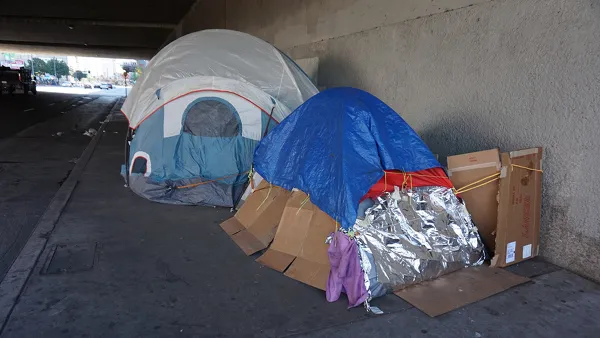
Los Angeles officials hope a new law will cut off one of the city's pipelines to homelessness.

Enforcing Housing Discrimination Laws Falls Largely on Tenants, Nonprofits
With few enforcement mechanisms even in cities that have bans on source-of-income discrimination on the books, it’s up to nonprofit lawyers and tenants to sue landlords for retribution.

Denver Law Would End Source-of-Income Discrimination
The law would prohibit Denver landlords from refusing Section 8 vouchers as rental payment.

Planetizen Federal Action Tracker
A weekly monitor of how Trump’s orders and actions are impacting planners and planning in America.

The state-sanctioned urbicide of Austin
People don’t kill cities. Freeways do.

US to reduce Colorado River water deliveries to Mexico
A new Colorado Treaty amendment reduces Mexico’s Colorado River water allocation by 250,000 acre feet.

Mamdani overhauls NYC's Vision Zero plan with 100 new policy goals
The overhaul aims to reduce traffic deaths and make streets safer for pedestrians, cyclists and drivers through lower speed limits, new safety infrastructure and more.

Amtrak not solely to blame for New Jersey commuter rail's unreliability, report finds
A new study from the Garden State Initiative found that NJ Transit’s budget grew 20% across a 4 year period, but reliability declined significantly over the same period.

EPA erases limits on planet-warming pollution from power plants
Under Monday’s plan, power plants would still have some limits on how much mercury, arsenic and other contaminants they can emit.

FREE Course: Walkable City 1: Why Walkability?
After describing his path towards focusing on walkability as the essence of good planning, Jeff Speck marches through his five principal reasons for making more walkable places.
Reinventing Malls: Planning Alchemy—Turning Gray Fields Into Gold
The course focuses on the opportunities and imperatives that shape reinvention of mall sites.

Eagle County Government
Harvard University Graduate School of Design
Nashville Planning Department
The Architects Foundation
University of Cincinnati Online
The Pocatello Development Authority
The Urban Renewal Agency of the City of Pocatello
Journal of the American Planning Association