Cities across the country have ambitious goals to move to renewable energy, but support at the federal level is lacking. A new program will assist cities with procurement and regulation of renewables.


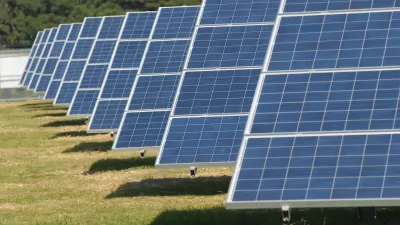
The American Cities Climate Challenge Renewables Accelerator will provide technical resources and tools to U.S. cities to help them reach their renewable energy goals. "The program will help cities procure and deploy large-scale, off-site renewable energy and navigate any regulations and laws that might impede progress," reports Chris Teale.
The Renewables Accelerator is a collaborative effort related to the American Cities Climate Challenge, a Bloomberg Philanthropies effort. "The 2.8 gigawatts of renewable capacity it aims to build is more than the existing solar capacity in Nevada, Florida or Texas, so cities will need to be creative in their procurement and deployment strategies," notes Teale.
The United States withdrew from the Paris climate accord in 2017. These programs reflect the desire of city leaders to be proactive in addressing climate change, particularly with what they see as a lack of national leadership.
Read the full story: Bloomberg-backed accelerator to help cities meet renewable energy goals

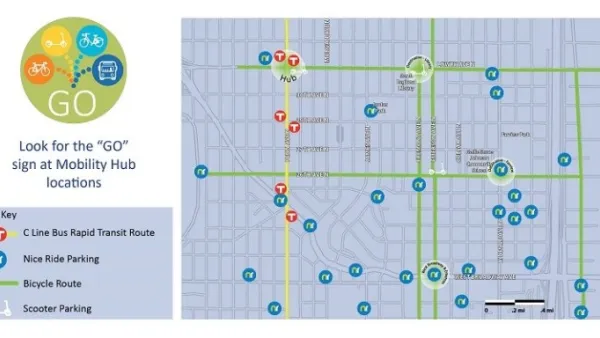
A Test Ride for Mobility Hubs
Offering multiple, non-automobile options for transportation in one place is the idea behind mobility hubs. The city of Minneapolis is now testing the concept at four locations.

2019 Certification for Cities Harnessing Data to Govern
The What Works Cities Certification recognizes cities across the country using data to inform local governance.

No Good News for Climate Stabilization From a New Worldwide Energy Report
Last month, the Paris-based International Energy Agency released its annual "Global Energy & CO2 Status Report." Energy consumption grew 2.3 percent with fossil fuels accounting for 70 percent on the increase. CO2 emissions jumped 1.7 percent.

Planetizen Federal Action Tracker
A weekly monitor of how Trump’s orders and actions are impacting planners and planning in America.

California plans to bury El Niño’s downpour
If the state plays its cards right, it may be able to store a billion acre-feet of El Niño’s water in aquifers.

Chicago breaks ground on $3 billion megadevelopment
The new neighborhood, titled Foundry Park, will one day host 3,700 residences.

Satanic Place Names
From streams and lakes to valleys and canyons, I mapped more than 1,000 places named after the Devil.

California High-Speed Rail Authority CEO resigns after $600,000 scandal
Under Ian Choudri, the authority used taxpayer dollars to fund first class flights and trips to nightclubs.

Want to study the Missouri River? Soon, you may need unanimous approval from 10 states
Legislation would require 10 governors’ permission to study or build projects moving water outside the basin.

FREE Course: Walkable City 1: Why Walkability?
After describing his path towards focusing on walkability as the essence of good planning, Jeff Speck marches through his five principal reasons for making more walkable places.
Reinventing Malls: Planning Alchemy—Turning Gray Fields Into Gold
The course focuses on the opportunities and imperatives that shape reinvention of mall sites.

City of Rosemead
Rutgers University, Edward J. Bloustein School of Planning and Public Policy
One Hundred Miles
Hunter College, City University of New York (CUNY)
The Architects Foundation
University of Cincinnati Online
City of Cambridge
Montrose County
The Pocatello Development Authority