The hot dogs cost $1,999,999,998 less than the stadium, and either $199,999,998 or $699,999,998 less than taxpayers invested in the stadium.


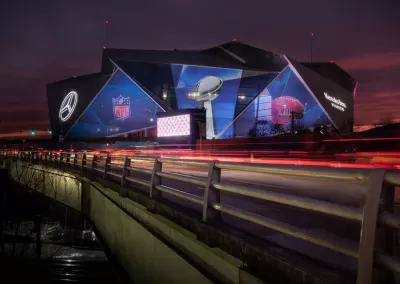
CBS News gives a tour of the Mercedes-Benz Stadium, home of the Super Bowl this year in Atlanta.
"The New England Patriots and Los Angeles Rams will face off on Super Bowl Sunday inside Atlanta's dazzling $2 billion Mercedes-Benz Stadium. In some ways, it's the real star of the big game."
The article is mostly a promotion for the engineering and architecture of the stadium, not to mention Arthur Blank, the owner of the Atlanta Falcons, which plays its home games in the stadium, and one of the co-founders of Home Depot.
Blank might own the team, but taxpayers are deeply invested in the stadium. An article from 2017 offers a good reminder of the controversy that followed the financing plan for the stadium. According to the article, written by Neil deMause, a discrepancy in the fine print created a $500 million gap between what the public initially agreed to invest and what it ended up investing.
CBS News doesn't mention that controversy, however.
Read the full story: Super Bowl 2019: Inside the $2 billion stadium where a hot dog only costs $2

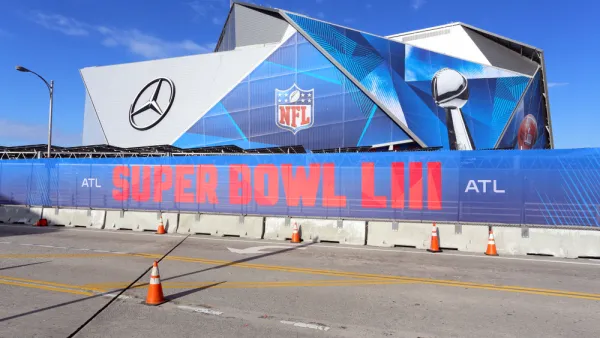
Pedestrian Bridge Won't Be Open in Time for the Super Bowl as Promised
The pedestrian bridge connecting Mercedes-Benz Stadium to a nearby transit stop won't be open in time for the Super Bowl, despite the city allocating an additional $12 million in funding for exactly that goal.

Sunday Fun: The Super Bowl in Atlanta on Social Media
Traffic and cars play a central role in the social media chatter surrounding the Super Bowl in Atlanta.
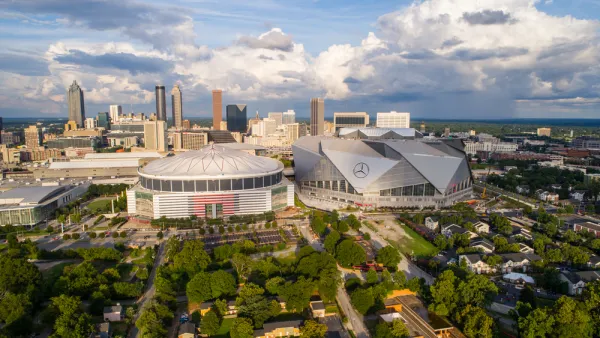
Atlanta Pedestrian Bridge—Not a Good Example of Public Dollars Well Spent
The bridge was touted as a connection between downtown and the Mercedes-Benz Stadium, but it is more a reflection of the city’s misplaced fiscal and planning priorities.

Planetizen Federal Action Tracker
A weekly monitor of how Trump’s orders and actions are impacting planners and planning in America.

California plans to bury El Niño’s downpour
If the state plays its cards right, it may be able to store a billion acre-feet of El Niño’s water in aquifers.

Chicago breaks ground on $3 billion megadevelopment
The new neighborhood, titled Foundry Park, will one day host 3,700 residences.

Satanic Place Names
From streams and lakes to valleys and canyons, I mapped more than 1,000 places named after the Devil.

California High-Speed Rail Authority CEO resigns after $600,000 scandal
Under Ian Choudri, the authority used taxpayer dollars to fund first class flights and trips to nightclubs.

Want to study the Missouri River? Soon, you may need unanimous approval from 10 states
Legislation would require 10 governors’ permission to study or build projects moving water outside the basin.

FREE Course: Walkable City 1: Why Walkability?
After describing his path towards focusing on walkability as the essence of good planning, Jeff Speck marches through his five principal reasons for making more walkable places.
Reinventing Malls: Planning Alchemy—Turning Gray Fields Into Gold
The course focuses on the opportunities and imperatives that shape reinvention of mall sites.

City of Rosemead
Rutgers University, Edward J. Bloustein School of Planning and Public Policy
One Hundred Miles
Hunter College, City University of New York (CUNY)
The Architects Foundation
University of Cincinnati Online
City of Cambridge
Montrose County
The Pocatello Development Authority