Stores like Dollar General and Dollar Tree are putting a lot of grocery stores out of business, leaving communities with fewer places to buy fresh produce.


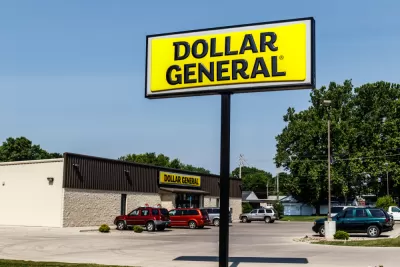
A growing portion of the United States lacks a grocery store, in part because their grocery stores can’t compete with Dollar stores. "These low-priced 'small-box' retailers, like Dollar General, offer little to no fresh food—yet they feed more Americans than either Trader Joe's or Whole Foods, and are gaining on the country’s largest food retailers,” Claire Kelloway reports for Civil Eats.
The Institute for Local Self-Reliance (ILSR) has published a study showing the way the story of dollar stores is tied to the long-running trend of consolidation in grocery stores. "The report makes the case that dollar stores undercut small rural grocers and hurt struggling urban neighborhoods by staving off full-service markets," Kelloway reports. Large chains like Kroger and Ahold-Delhaize buy up smaller chains and eliminate less profitable locations, leaving fewer local grocers. Those that remain struggling to compete. "These dominant chain stores have decimated independent retailers and divested from rural and low-income areas, as well as communities of color," Kelloway writes.
"Some, including dollar-store executives themselves, argue that a low-cost retailer seeking to go where no one else will benefits underserved communities," Kelloway reports. The ISLR counters that these stores have done a great deal to make the areas around them less desirable, by putting local grocery stores out of business.
FULL STORY: Dollar Stores Are Taking Over the Grocery Business, and It’s Bad News for Public Health and Local Economies

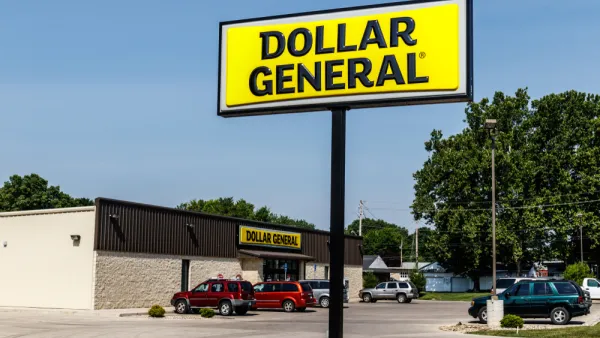
In Tulsa, Pushing Back on the Dollar Store Incursion
Restrictions in North Tulsa are part of a backlash against the dollar stores flooding communities that are food deserts in need of real grocery stores.
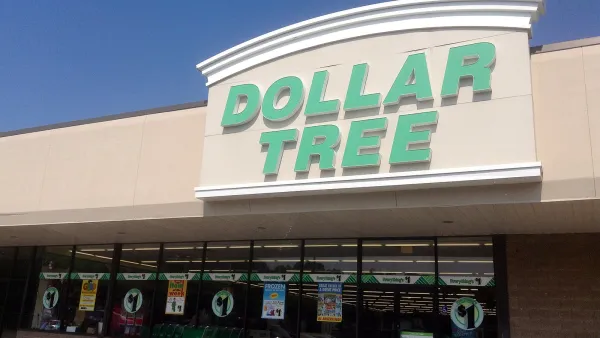
Dollar Stores Close to Half of New Store Openings in 2021
Expanding wealth inequality has contributed to the explosive growth of "dollar store" retailers.
Dollar Stores and Grocery Stores
Opponents of dollar stores argue that dollar stores are the mortal enemy of grocery stores. Is this really true?

Planetizen Federal Action Tracker
A weekly monitor of how Trump’s orders and actions are impacting planners and planning in America.

The state-sanctioned urbicide of Austin
People don’t kill cities. Freeways do.

US to reduce Colorado River water deliveries to Mexico
A new Colorado Treaty amendment reduces Mexico’s Colorado River water allocation by 250,000 acre feet.

5 New England states march closer to 800 megawatt wind energy project
Securing federal approval for the project may be complicated under the Trump administration, which has historically been hostile towards domestic wind power.

Baltimore to break ground on $50 million Transit Priority Project
The project will bring faster bus trips, safer streets and better bike connections to Baltimore.

Airbnb launches $250 million 'last-dollar financing' housing accelerator, makes first investment in Austin
The company will put $6.4 million towards affordable housing development in Texas’ capital.

FREE Course: Walkable City 1: Why Walkability?
After describing his path towards focusing on walkability as the essence of good planning, Jeff Speck marches through his five principal reasons for making more walkable places.
Reinventing Malls: Planning Alchemy—Turning Gray Fields Into Gold
The course focuses on the opportunities and imperatives that shape reinvention of mall sites.

Eagle County Government
Harvard University Graduate School of Design
Nashville Planning Department
The Architects Foundation
University of Cincinnati Online
The Pocatello Development Authority
The Urban Renewal Agency of the City of Pocatello
Journal of the American Planning Association