The first comprehensive look at social capital in a Canadian city reveals lessons for planners and more about what connects citizens to their communities.


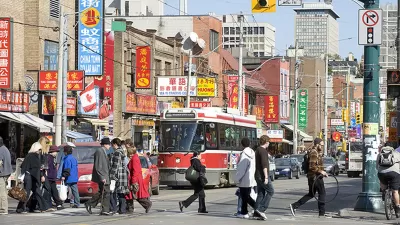
"Toronto — a city of more than 2.8 million people where 51 per cent of residents are visible minorities — exhibits remarkably high levels of social capital," reports Laurie Monsebraaten, broadcasting the findings of report released this week by the non-profit Toronto Foundation and Environics Institute for Survey Research.
"Social capital is the 'lubricant' that drives social networks, determines trust and makes it possible for people who may have little in common to live peacefully with each other," explains Monsebraaten. "The foundation hopes the research…will help academics, planners, activists and philanthropists guide investment in communities and help those who are most vulnerable."
Since this was the first study of social capital in a Canadian city, the study raises obvious questions about how Toronto compares to U.S. cities where similar analysis has been completed. "In contrast to some of the research evidence for U.S. cities, this study found no evidence in Toronto that increasing ethnic diversity is linked to lower levels of social capital," quoting directly from the report.
Read the full story: In Toronto, we trust: Groundbreaking study shows city’s social capital is remarkably high

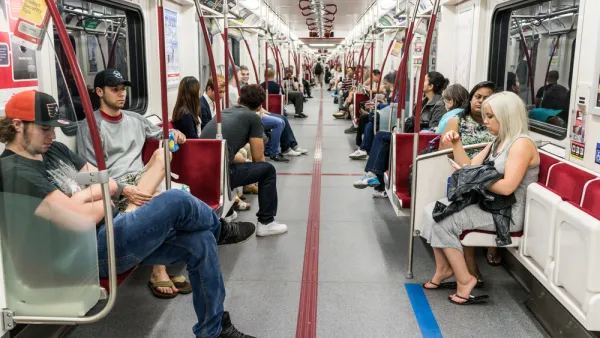
As Canada Grows, Transit a Key Component of Success
The population in Canada will increase substantially in the future, and transit planning is crucial to ensuring that cities thrive.
Quality of Life Down in Golden State
A new poll of California residents finds that perceived quality of life in the state has dropped.
Americans Moving Less, Getting Rooted
In the 1950s, nearly 1/5 of Americans moved each year. That trend is quickly reversing. Americans are now staying put in greater numbers than at any time since World War II, and experts have plenty of opinions on why that is.

Planetizen Federal Action Tracker
A weekly monitor of how Trump’s orders and actions are impacting planners and planning in America.

Amtrak, CN end decades-long dispute with eight-year agreement
The new operating agreement establishes an updated framework for the companies to work together, including processes to resolve disputes.

Judges permit Denver to divert 77,000 acre feet from the Colorado River for reservoir expansion
Overuse and climate change have caused the Colorado River’s water levels to plummet.

NYC DOT wants faster, more permanent street upgrades
The city is examining ways to build more concrete infrastructure without getting entangled in 'decades-long' projects.

'Something we’ve never seen before:' rising utility rates could strain city finances nationwide
Data centers, climate change and other factors have caused utility rates in the United States to increase by 38% since 2020.

Trump to overrule local leaders, lease millions of acres of America’s Pacific Island territories’ seafloors to mining companies
International law says that the Indigenous people of America’s territories have a right to prior and informed consent regarding projects that impact their countries.

FREE Course: Walkable City 1: Why Walkability?
After describing his path towards focusing on walkability as the essence of good planning, Jeff Speck marches through his five principal reasons for making more walkable places.
Reinventing Malls: Planning Alchemy—Turning Gray Fields Into Gold
The course focuses on the opportunities and imperatives that shape reinvention of mall sites.

Harvard University Graduate School of Design
KFH Group Inc.
Greater Baltimore Committee
The Architects Foundation
University of Cincinnati Online
The Pocatello Development Authority
The Urban Renewal Agency of the City of Pocatello