A contentious initiative on the Alaska ballot next month pits protecting salmon habitat protections against the interests of the oil and gas industry and mining companies.


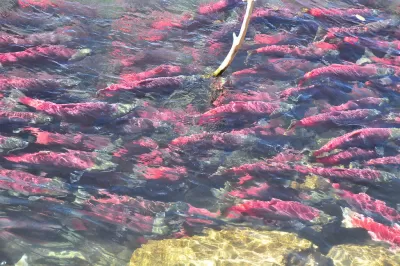
"The ballot measure pits the state's love for salmon against its need for oil and mining revenue," states the NPR Morning Edition host.
The controversial measure has drawn more money than all three gubernatorial candidates combined. It's also a hot-button topic in this gubernatorial race.
Elizabeth Harball, Alaska Public Media's energy desk reporter, talks to the proponents and opponents of Alaska Ballot Measure 1, Salmon Habitat Protections and Permits Initiative (2018) in the source article [audio-only as of Tuesday evening].
"The measure looks to establish new [anadromous] fish habitat guidelines for permitting large-scale projects like mining, or oil and gas," notes a KTVA broadcast of an Oct. 4 debate hosted by Alaska Common Ground exploring the pros and cons of the salmon habitat ballot initiative. The measure was placed on the ballot by a petition drive sponsored by a coalition, Save the Salmon, which includes The Alaska Center and Cook Inletkeeper, affiliated with Waterkeeper Alliance.
According to the proponents, "salmon populations across Alaska have been declining in recent years, and our 60-year-old laws, intended to protect Alaska salmon habitat for future generations, have become outdated and ineffective."
Parts of the initiative was successfully contested by the state attorney general's office, but the remainder could go forward, reported Harball.
Lawyers for the state, who challenged the initiative in court, are also counting the outcome as a win. That's because they weren't arguing whether Yes for Salmon is good policy or not — they just said it violated a specific part of the Alaska constitution. Now that the Supreme Court took out the unconstitutional provisions, the state's narrow legal challenge ends.
Opposing the measure is Stand for Alaska, "backed by the state's biggest oil, gas and mining companies, like BP, ConocoPhillips, the Pebble Limited Partnership and Donlin Gold, as well as Alaska Native corporations, trade unions and other groups," wrote Harball. According to the group, the measure "poses a threat to Alaska's communities, our jobs and our economy by adding complicated red tape that will impact private property owners and companies alike."
The measure is classified as an indirect initiated state statute, meaning that it qualified by petition gathering and was sent to the legislature which could have adopted it outright, amended and then approved it, or placed a competing measure on the ballot. "Nine states out of the 21 with initiated state statutes allow for this process," according to Ballotpedia.
FULL STORY: Energy Companies In Alaska Fight Controversial Salmon Initiative


Voters in Four States to Decide on Transportation Sales and Fuel Taxes
Californians will determine whether to repeal recent fuel tax and user fee increases; Missourians to vote on a 10-cent gas tax hike over 4 years; Coloradans whether to hike the sales tax, and the most interesting measure will be decided in Utah.

Oil and Gas Drilling Issues Loom Large in Colorado on Election Day
Unlike prior initiatives that sought drilling bans, Prop. 112 would greatly increase setbacks from buildings to such an extent that it could doom much of the industry. A competing initiative would make the change a "taking" and require compensation.

Oil Industry Withdraws Ballot Measure, Shifts to Legal Fight Over California Well Restrictions
California's oil industry has withdrawn its ballot measure challenging a law that restricts oil and gas wells near homes and schools, opting to contest the law in court.

Planetizen Federal Action Tracker
A weekly monitor of how Trump’s orders and actions are impacting planners and planning in America.

The state-sanctioned urbicide of Austin
People don’t kill cities. Freeways do.

US to reduce Colorado River water deliveries to Mexico
A new Colorado Treaty amendment reduces Mexico’s Colorado River water allocation by 250,000 acre feet.

Mamdani overhauls NYC's Vision Zero plan with 100 new policy goals
The overhaul aims to reduce traffic deaths and make streets safer for pedestrians, cyclists and drivers through lower speed limits, new safety infrastructure and more.

Amtrak not solely to blame for New Jersey commuter rail's unreliability, report finds
A new study from the Garden State Initiative found that NJ Transit’s budget grew 20% across a 4 year period, but reliability declined significantly over the same period.

EPA erases limits on planet-warming pollution from power plants
Under Monday’s plan, power plants would still have some limits on how much mercury, arsenic and other contaminants they can emit.

FREE Course: Walkable City 1: Why Walkability?
After describing his path towards focusing on walkability as the essence of good planning, Jeff Speck marches through his five principal reasons for making more walkable places.
Reinventing Malls: Planning Alchemy—Turning Gray Fields Into Gold
The course focuses on the opportunities and imperatives that shape reinvention of mall sites.

Eagle County Government
Harvard University Graduate School of Design
Nashville Planning Department
The Architects Foundation
University of Cincinnati Online
The Pocatello Development Authority
The Urban Renewal Agency of the City of Pocatello
Journal of the American Planning Association