As cities swell and car use soars, U.S. cities should take note of some bold, even radical, emissions-reducing policies being deployed around Europe.


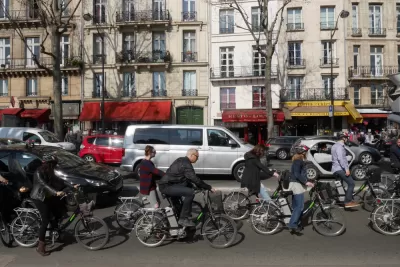
Transportation and clean air are at odds with one another, and as transportation-sourced CO2 emissions continue to rise in the U.S., American cities would do well to consider transportation policies that both mitigate emissions and support economic vitality.
To appreciate the severity of the problem, it would help to start with these facts: for two years running, transportation has surpassed all other sectors as the biggest contributor to greenhouse gas emissions in the U.S., according to data released by the Energy Information Administration in March.
For decades the top carbon emitter in the U.S. was the power sector, in large part because of coal. But that all changed in 2016 when, for the first time, transportation outpaced all other sectors–more than agriculture, industry, and even electricity generation–accounting for 28 percent of U.S. greenhouse gas emissions.
And while cars, trucks, commercial aircraft, and railroads all contribute to transportation sector emissions, light-duty passenger cars and trucks–basically your typical commuter car and pick-up truck–account for 60 percent of all transportation greenhouse gas emissions.
Which is why U.S. cities should take note of some bold, even radical, emissions-reducing policies being deployed around Europe.
Take Germany, for example, which surprised the world in February with a five-city pilot proposal to reduce the number of private cars by making public transportation free–or at least ticketless.
"Effectively fighting air pollution without any further unnecessary delays is of the highest priority for Germany," three ministers wrote in a letter to EU environment commissioner Karmenu Vella in Brussels.
Though details have yet to emerge about how Germany plans to fund the initiative, ticketless public transportation programs aren't new.
Estonia's capital city, Tallinn, introduced fareless public transport for residents in 2013. To fund the measure, the city of Tallinn gets 1,000 euros a year from residents' income tax. Nonresidents and tourists must still purchase tickets.
The results have been impressive. Population numbers in the city have increased, and the overall city budget has grown, according to Edgar Savisaar, the populist mayor who introduced the fiscal law.
"The lost ticket revenue from residents is 12 million euros ($15 million)," Savisaar said. "The gain from additional revenues from the increase in the residential population, at the most conservative estimate, is well above 20 million euros ($25 million)."
In fact, the Tallinn initiative has been so successful that the central government earlier this year rolled out ticketless bus travel for the whole country.
And if fighting emissions with ticketless transportation isn't audacious enough for you, consider these policies directed directly at cars.
Oslo, Norway, plans to permanently ban all cars from its city center by 2019 – six years ahead of Norway's county-wide ban on petrol-based cars, going into effect in 2025. Oslo will also invest heavily in public transportation and replace 35 miles of roads with bike lanes.
And you have to love the French: when the city of Paris banned all cars with even-numbered plates from entering the city for a day in 2014, pollution dropped by 30%. Inspired, in July 2016 the city banned all cars made before 1997 from driving in the city center on weekdays–though they are permitted on the weekend. Furthermore, the city government plans to double its bike lanes and limit select streets to electric cars by 2020.
But perhaps nothing compares to the city center of Ljubljana, Slovenia, where you must park your car at an underground garage outside the car-free area. The only exception is for the elderly, disabled people, or mothers with young children. They are offered free rides in electric taxis. Bicycles and buses are also permitted in this zone.
At first, local businesses in Ljubljana were worried the scheme would hurt trade, but quite the opposite happened. Business and tourism have increased, according to the World Economic Forum. And thanks to the city's policies, traffic has decreased by 12% since 2011.
So what do all these cities have in common?
A keen understanding that public transportation, walking, and bicycling are not only unbeatable when it comes to fighting CO2 emissions, but they have the added benefit of increasing home values, costing taxpayers less, attracting tourists, and supporting vibrant, interactive economies.
So as US cities swell and car use soars, keep an open mind to some of the more innovative ways Europeans are mitigating their CO2 emissions.
Sure, prioritizing walking, biking and public transportation will cut into our drive-through culture, but at least we will all breathe easier.

Making Climate Change a Priority for Transportation Planning
The threat of climate change has not guided transportation planning in Chicago, and the city and region could be doing much more to promote sustainable transportation, according to the article.

Vancouver's Ride-Hail-Free Mobility Landscape
While ride-hailing is on the horizon for the Canadian city, the experience so far without the mode provides useful insight into its effects on regional mobility.

These Streets Were Made for Walking
Many streets and cities are designed for vehicles instead of for pedestrians. But policies and programs in cities around the world, and even in the United States, might be signaling a shift in priorities.

Planetizen Federal Action Tracker
A weekly monitor of how Trump’s orders and actions are impacting planners and planning in America.

Amtrak, CN end decades-long dispute with eight-year agreement
The new operating agreement establishes an updated framework for the companies to work together, including processes to resolve disputes.

Judges permit Denver to divert 77,000 acre feet from the Colorado River for reservoir expansion
Overuse and climate change have caused the Colorado River’s water levels to plummet.

NYC DOT wants faster, more permanent street upgrades
The city is examining ways to build more concrete infrastructure without getting entangled in 'decades-long' projects.

'Something we’ve never seen before:' rising utility rates could strain city finances nationwide
Data centers, climate change and other factors have caused utility rates in the United States to increase by 38% since 2020.

Trump to overrule local leaders, lease millions of acres of America’s Pacific Island territories’ seafloors to mining companies
International law says that the Indigenous people of America’s territories have a right to prior and informed consent regarding projects that impact their countries.

FREE Course: Walkable City 1: Why Walkability?
After describing his path towards focusing on walkability as the essence of good planning, Jeff Speck marches through his five principal reasons for making more walkable places.
Reinventing Malls: Planning Alchemy—Turning Gray Fields Into Gold
The course focuses on the opportunities and imperatives that shape reinvention of mall sites.

Harvard University Graduate School of Design
KFH Group Inc.
Greater Baltimore Committee
The Architects Foundation
University of Cincinnati Online
The Pocatello Development Authority
The Urban Renewal Agency of the City of Pocatello

