The MTA is studying how a Thermal Energy Network could capture extreme excess heat from subway platforms to warm nearby municipal buildings.


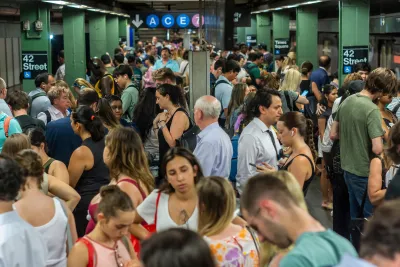
New York City transit riders might one day experience relief from the oppressive heat that plagues subway platforms in the summer — and provide heat to nearby buildings in the winter in the process.
The Metropolitan Transportation Authority recently launched a study to explore the creation of a Thermal Energy Network that would capture extreme excess heat on subway platforms in the summer, store it in geothermal boreholes and recycle it to warm nearby municipal buildings during the winter.
"TENs, already in use at several hospitals and universities, move heat between buildings, reducing reliance on fossil fuels. The MTA and city are set to assess the feasibility of using TENs and geothermal infrastructure to absorb, store and transport excess heat between subway stations and adjacent municipal buildings," writes Noah Kolenda for Mass Transit.
The initial feasibility study, projected to cost $800,000, will test the process at the Brooklyn Bridge-City Hall 4/5/6 and Chambers Street J/Z station complex to determine how much cooling can be achieved and the potential energy cost savings for the city. It will use radiant cooling technology, which removes heat by circulating chilled water through panels and tubing embedded in floors and walls, allowing cool surfaces to absorb heat. The process can be up to 35% more energy efficient than air conditioning.
Read the full article at Mass Transit, below.
Read the full story: MTA to study thermal energy network to reduce subway platform heat

MTA looks to bring AI-assisted, multilingual announcement system to subways
Some of the transit agency’s audio systems haven’t been upgraded in 40 years.
Cool Routes app plots shady walks in arid Arizona
Alternate routes provided by the app reduced the heat experienced during the walk by an average of 4.5 degrees.

The Pacific Northwest is an unlikely front in the fight for cooling
A 2021 heat dome killed over 250 people in the Pacific Northwest, bringing into sharp focus the potential of extreme heat to have deadly consequences even in historically cool climates.

Planetizen Federal Action Tracker
A weekly monitor of how Trump’s orders and actions are impacting planners and planning in America.

Northwest rail fans eager for Sept. 30 debut of Amtrak’s Airo fleet
Get ready for that new train smell and more seats. But they won’t go faster or run more frequently on the Cascades route in Washington and Oregon.
Record-breaking wildlife overpass in Colorado brings 91% reduction in animal collisions
Prior to the overpass, vehicles were hitting one deer per day on Colorado’s Interstate 25.

Detroit to transform waterfront with $2.2 billion investment
Developers will convert about 18 acres of unused parking lot space into civic spaces.

‘Going backwards:’ Baltimore mayor, students rally against state's transit funding plan
Maryland's proposed six-year plan provides no funding for Baltimore’s BMORE bus program and reduces its road maintenance funding.

Trump wants to cancel nearly 98% of funding for HUD housing support program
Multiple housing groups are suing the administration in an effort to preserve the funding.

FREE Course: Walkable City 1: Why Walkability?
After describing his path towards focusing on walkability as the essence of good planning, Jeff Speck marches through his five principal reasons for making more walkable places.
Reinventing Malls: Planning Alchemy—Turning Gray Fields Into Gold
The course focuses on the opportunities and imperatives that shape reinvention of mall sites.

City of Thousand Oaks
City of Wisconsin Rapids
Harvard University Graduate School of Design
The Architects Foundation
University of Cincinnati Online
Northern Illinois Transit Authority (NITA)
The Pocatello Development Authority
The Urban Renewal Agency of the City of Pocatello