A new study shows that the West Coast's major fault system is in 'a critically loaded state.'


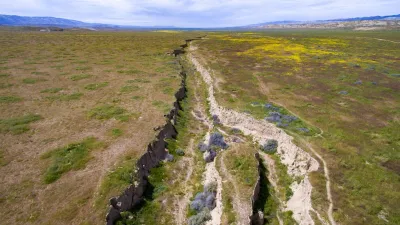
California's San Andreas fault is experiencing the highest levels of tectonic stress in 1,000 years, according to research from the University of Hawaiʻi at Mānoa.
According to lead study author Liliane Burkhard, "Our results show that stress levels on multiple fault segments are now at or above the highest values seen in the past millennium and that the region may be capable of a large through-going rupture involving both fault systems."
The findings are based on a computer model that simulates stress buildup using 1,000 years of earthquake history. "Results from this study suggest that the stress that would normally be released in large earthquakes has continued to accumulate and is now at unprecedented levels. Perhaps most importantly, the study showed that Cajon Pass could facilitate a joint rupture of both the San Andreas and San Jacinto faults simultaneously, which is a scenario that could be significantly more damaging than a single-fault event, and one that affects densely populated areas including Los Angeles, San Bernardino, Riverside and the Coachella Valley."
Read the full story: San Andreas fault reaches highest stress level in 1,000 years

Los Angeles County the Riskiest Place in the U.S., FEMA Says
The new National Risk Index calculates the brutal equations of natural disasters.

Five Years of 100 Resilient Cities
It's been five years since the Rockefeller Foundation launched the 100 Resilient Cities initiative. A new analysis by the Urban Institute evaluates the accomplishments of 100 Resilient Cities so far.
Want an Earthquake Warning? There's an App for That
A new earthquake warning system is in place in the city of Los Angeles.

Planetizen Federal Action Tracker
A weekly monitor of how Trump’s orders and actions are impacting planners and planning in America.

California plans to bury El Niño’s downpour
If the state plays its cards right, it may be able to store a billion acre-feet of El Niño’s water in aquifers.

Desperate measures: Advocates weigh draining Lake Powell to fill Colorado River
Draining the reservoir could reduce evaporation losses by a couple hundred thousand acre-feet.

In Texas, data centers are swallowing promised parkland
Residents who moved to Taylor, Texas for a rural community now have to contend with three data centers in their backyard.

How a Chicago-sized wind farm beat the odds and powered on
The project spanned five presidential administrations and a standoff with a U.S. military base.

MTA gives itself 30 days to transform pit into basketball court
The site has been under construction since 2022; the city originally estimated it would finish the court in 2024.

FREE Course: Walkable City 1: Why Walkability?
After describing his path towards focusing on walkability as the essence of good planning, Jeff Speck marches through his five principal reasons for making more walkable places.
Reinventing Malls: Planning Alchemy—Turning Gray Fields Into Gold
The course focuses on the opportunities and imperatives that shape reinvention of mall sites.

City of Rosemead
Rutgers University, Edward J. Bloustein School of Planning and Public Policy
One Hundred Miles
Hunter College, City University of New York (CUNY)
The Architects Foundation
University of Cincinnati Online
City of Cambridge
Montrose County
The Pocatello Development Authority