Concentrating housing near frequent, reliable transit offers advantages to both residents and transit agencies, who can serve more riders more efficiently.


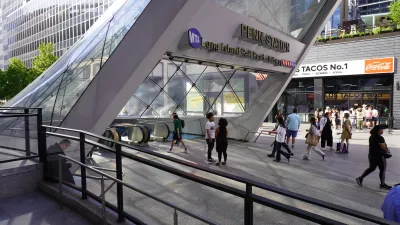
A new interactive tool from the Urban Institute explores investment in transit-oriented development across the country. Using the data, UI researcher Yonah Freemark analyzes which U.S. cities have developed the most effective TOD policies that put residents near buses and trains.
According to Freemark, "Residents of the New York City, San Francisco, and Washington, DC, regions have more than four times the amount of bus and rail service per capita as residents in Detroit, Indianapolis, and Memphis." Consequently, residents of these cities use transit seven times as frequently as Americans in other regions.
"We find that most of the nation’s large urban areas provide bus or train service within walking distance of most housing units. Among these regions, Los Angeles and San Francisco perform best, each providing transit service within a half mile of at least 90 percent of homes, while Atlanta, Dallas, and Houston provide service within a half mile to fewer than half of all homes." However, the frequency and reliability of service makes a difference. "From this perspective, New York and San Francisco perform best, with at least 40 percent of housing units located near services that arrive at least every 15 minutes between noon and 1 p.m., indicative of midday service."
According to Freemark, "among the 26 urban areas with a substantial rail system, most had less than 20 percent of their regional housing growth in areas served by rail between 1980 and 2022, though New York, San Francisco, and San José added at least 30 percent of regional growth near rail during this period."
FULL STORY: Transit-Oriented Development Can Help Cities Grow. Which Urban Areas Are Doing Best?

Opinion: California’s SB 79 Would Improve Housing Affordability and Transit Access
A proposed bill would legalize transit-oriented development statewide.
California Bill Aims to Boost TOD
A bill proposed by Sen. Scott Wiener would exempt transit agencies from zoning rules near ‘high-quality’ transit stops and allow denser transit-oriented development.
San Diego wants to limit upzoning law to just 16% of transit-adjacent parcels
The city's planning director says some areas are unfit for immediate upzoning due to a lack of resources or hazards such as wildfire risk.

The state-sanctioned urbicide of Austin
People don’t kill cities. Freeways do.

US to reduce Colorado River water deliveries to Mexico
A new Colorado Treaty amendment reduces Mexico’s Colorado River water allocation by 250,000 acre feet.

New Jersey’s second-largest city bans standalone data centers
Jersey City will continue to allow co-location facilities, such as those meant for research institutions that store their own data.

Amtrak not solely to blame for New Jersey commuter rail's unreliability, report finds
A new study from the Garden State Initiative found that NJ Transit’s budget grew 20% across a 4 year period, but reliability declined significantly over the same period.

EPA erases limits on planet-warming pollution from power plants
Under Monday’s plan, power plants would still have some limits on how much mercury, arsenic and other contaminants they can emit.

Phoenix announces new on-demand transit service, more frequent RAPID buses
Both new services will launch in October, and are part of Phoenix's Project Effective Access Solutions for Easing Congestion.

FREE Course: Walkable City 1: Why Walkability?
After describing his path towards focusing on walkability as the essence of good planning, Jeff Speck marches through his five principal reasons for making more walkable places.
Reinventing Malls: Planning Alchemy—Turning Gray Fields Into Gold
The course focuses on the opportunities and imperatives that shape reinvention of mall sites.

Eagle County Government
Harvard University Graduate School of Design
Nashville Planning Department
The Architects Foundation
University of Cincinnati Online
The Pocatello Development Authority
The Urban Renewal Agency of the City of Pocatello
Journal of the American Planning Association