A proposed law would tax data center operators for high power use and incentivize them to increase energy efficiency.



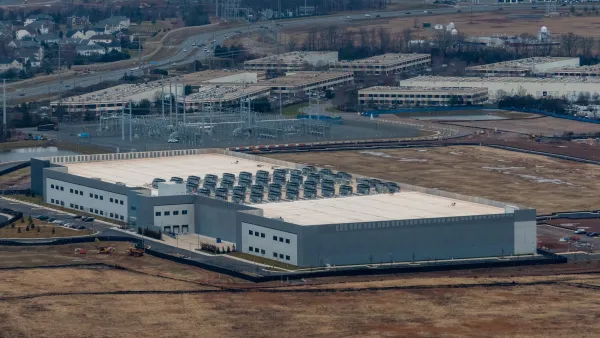
A New Jersey state senate panel advanced a bill that would call for the creation of a new tariff on “large-load” data centers to mitigate their impacts on local power supplies and protect residents and other ratepayers from increased costs, reports Dana DiFilippo in New Jersey Monitor.
New Jersey’s utility rates are already 20 percent higher than the national average.“The bill would require public electric utilities to submit proposed tariffs to the state Board of Public Utilities and incentivize data centers to increase energy efficiency by adopting technologies that capture and use the heat they generate.”
PJM Interconnection, the region’s energy grid operator, says “it expects energy demand in its 13-state service area to grow 32 gigawatts by 2030, with most — 30 gigawatts — coming from data centers.” Alex Ambrose of progressive think tank New Jersey Policy Perspective says that, in lieu of federal regulations, “We need [state] guardrails to protect people from higher bills.”
FULL STORY: New Jersey lawmakers OK plan to charge data centers for spiking electric costs

Data center developer offers over $4M per acre to buy out homeowners
Data center builders are outbidding home builders for land, prompting concerns about competition with housing.

Over half of Colorado's energy now comes from renewables
In the first quarter of 2026, renewables made up 53% of Colorado's electricity, up from 43% in 2025.

Boulder City appeals BLM approval of data center on public land
The data center's developer previously applied for a permit to build a solar farm, a project Boulder officials say is a far cry from the more energy-intensive data center now being proposed.

Planetizen Federal Action Tracker
A weekly monitor of how Trump’s orders and actions are impacting planners and planning in America.

The state-sanctioned urbicide of Austin
People don’t kill cities. Freeways do.

US to reduce Colorado River water deliveries to Mexico
A new Colorado Treaty amendment reduces Mexico’s Colorado River water allocation by 250,000 acre feet.

5 New England states march closer to 800 megawatt wind energy project
Securing federal approval for the project may be complicated under the Trump administration, which has historically been hostile towards domestic wind power.

Baltimore to break ground on $50 million Transit Priority Project
The project will bring faster bus trips, safer streets and better bike connections to Baltimore.

Airbnb launches $250 million 'last-dollar financing' housing accelerator, makes first investment in Austin
The company will put $6.4 million towards affordable housing development in Texas’ capital.

FREE Course: Walkable City 1: Why Walkability?
After describing his path towards focusing on walkability as the essence of good planning, Jeff Speck marches through his five principal reasons for making more walkable places.
Reinventing Malls: Planning Alchemy—Turning Gray Fields Into Gold
The course focuses on the opportunities and imperatives that shape reinvention of mall sites.

Eagle County Government
Harvard University Graduate School of Design
Nashville Planning Department
The Architects Foundation
University of Cincinnati Online
The Pocatello Development Authority
The Urban Renewal Agency of the City of Pocatello
Journal of the American Planning Association