The city plans to upgrade the park’s drainage infrastructure to channel more stormwater into its lake and other drainage ponds and reduce flooding risk.


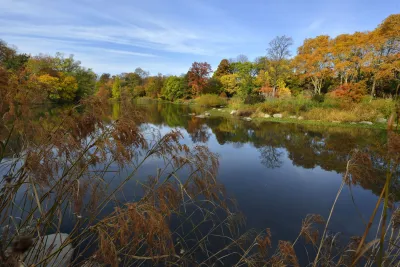
New York City is planning a $68 million ‘Bluebelt’ system in Brooklyn to reduce flash flooding in the borough. As Robyn Griggs Lawrence explains in Smart Cities Dive, the plan includes upgrading Prospect Park Lake’s drainage infrastructure and building new ponds and rain gardens. The project is crucial as annual rainfall in New York City is projected to increase by up to 14 percent by the 2050s.
The project is the result of a study from the city’s Department of Environmental Protection which found that water during storms often rushes over the ground instead of flowing into the lake, whose limited capacity can cause it to overflow. “DEP, NYC’s Department of Parks & Recreation and the Prospect Park Alliance will collaborate on upgrading the lake’s drainage infrastructure, building a new pond and a continuous stretch of rain gardens that will slow and filter rainwater as it drains to the lake and restore a pond that was filled in north of the Prospect Park Zoo to collect rainwater from Flatbush Avenue.”
According to Griggs Lawrence, “The project is intended to complement the $20 million Lakeshore Restoration Plan, which will reconstruct Prospect Park Lake’s shoreline with green infrastructure for stormwater management.”
The city built its first Bluebelt project in Staten Island in 2023, where new infrastructure filters stormwater into catch basins and storm sewers before it reaches lower New York Bay.
Read the full story: Facing extreme rainfall and flooding, NYC is turning Brooklyn’s Prospect Park into a natural buffer

New York Flood Control Plan Takes Lessons From the Dutch
The Netherlands has a long history of flood mitigation. U.S. cities, threatened by coastal flooding and erosion, are taking note.
East River Floodgates Rising in NYC
A tour of new infrastructure designed to protect the city’s East Side from catastrophic flooding.

Flood Resilience Through Green Infrastructure
Cities like New York and Los Angeles are moving to build green infrastructure as the need for spongier urban spaces becomes more apparent.

Planetizen Federal Action Tracker
A weekly monitor of how Trump’s orders and actions are impacting planners and planning in America.

California plans to bury El Niño’s downpour
If the state plays its cards right, it may be able to store a billion acre-feet of El Niño’s water in aquifers.

Chicago breaks ground on $3 billion megadevelopment
The new neighborhood, titled Foundry Park, will one day host 3,700 residences.

California High-Speed Rail Authority CEO resigns after $600,000 scandal
Under Ian Choudri, the authority used taxpayer dollars to fund first class flights and trips to nightclubs.

Want to study the Missouri River? Soon, you may need unanimous approval from 10 states
Legislation would require 10 governors’ permission to study or build projects moving water outside the basin.

Desperate measures: Advocates weigh draining Lake Powell to fill Colorado River
Draining the reservoir could reduce evaporation losses by a couple hundred thousand acre-feet.

FREE Course: Walkable City 1: Why Walkability?
After describing his path towards focusing on walkability as the essence of good planning, Jeff Speck marches through his five principal reasons for making more walkable places.
Reinventing Malls: Planning Alchemy—Turning Gray Fields Into Gold
The course focuses on the opportunities and imperatives that shape reinvention of mall sites.

City of Rosemead
Rutgers University, Edward J. Bloustein School of Planning and Public Policy
One Hundred Miles
Hunter College, City University of New York (CUNY)
The Architects Foundation
University of Cincinnati Online
City of Cambridge
Montrose County
The Pocatello Development Authority