Rather than funding the performative militarization of law enforcement, the federal government could instead support programs that prevent poverty and crime before it happens.


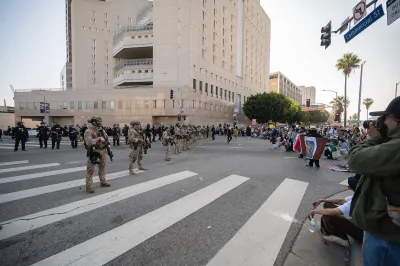
In a post originally written in October and updated this month in his Architecture and the City Substack newsletter, James S. Russell asserts that the popular notion that cities are loci of crime and disorder — weaponized by the Trump administration in its efforts to deploy military troops to U.S. cities — is wrong.
According to Russell, cities are, in fact, innovators of anti-crime policies. “Cities have devised programs to reduce youth offending, thereby undercutting the growth of gangs and their way of turning minor criminals into hardened ones. Some nonprofits focus on helping aimless children lacking mentors to stay in school. “Violence interruptors” are credible messengers to otherwise unpersudable [sic] young people because they can speak from their own experiences in gangs and prison.” These policies must work in conjunction with stable housing, effective schools with ample resources, and readily available health care (and mental health care).
For Russell, “Growing wealth and opportunity has proven to be the best crime-reduction strategy. States and the federal government have too often gotten in the way.” By funding performative, militarized law enforcement over education, housing, and other tools that deter crime, governments stifle the efforts of cities and nonprofits.
FULL STORY: Troops Wreck Cities


How urban design can deter crime
Well-designed public spaces and good lighting can prevent crime and make residents feel safer.
Police Take Control of D.C. Neighborhood
Washington, D.C. police decide to stop everyone entering a neighborhood that has seen 22 killings so far this year, including a recent triple homicide.

The Link Between Urban Design and Crime
A meta-study shows that public realm interventions can help reduce crime rates.

The state-sanctioned urbicide of Austin
People don’t kill cities. Freeways do.

US to reduce Colorado River water deliveries to Mexico
A new Colorado Treaty amendment reduces Mexico’s Colorado River water allocation by 250,000 acre feet.

New Jersey’s second-largest city bans standalone data centers
Jersey City will continue to allow co-location facilities, such as those meant for research institutions that store their own data.

Amtrak not solely to blame for New Jersey commuter rail's unreliability, report finds
A new study from the Garden State Initiative found that NJ Transit’s budget grew 20% across a 4 year period, but reliability declined significantly over the same period.

EPA erases limits on planet-warming pollution from power plants
Under Monday’s plan, power plants would still have some limits on how much mercury, arsenic and other contaminants they can emit.

Phoenix announces new on-demand transit service, more frequent RAPID buses
Both new services will launch in October, and are part of Phoenix's Project Effective Access Solutions for Easing Congestion.

FREE Course: Walkable City 1: Why Walkability?
After describing his path towards focusing on walkability as the essence of good planning, Jeff Speck marches through his five principal reasons for making more walkable places.
Reinventing Malls: Planning Alchemy—Turning Gray Fields Into Gold
The course focuses on the opportunities and imperatives that shape reinvention of mall sites.

Eagle County Government
Harvard University Graduate School of Design
Nashville Planning Department
The Architects Foundation
University of Cincinnati Online
The Pocatello Development Authority
The Urban Renewal Agency of the City of Pocatello
Journal of the American Planning Association