The row house is ubiquitous in the two cities, but their policies on design and preservation vary widely.



In a piece for North Penn Now, Chris Bates highlights the importance of row houses in Philadelphia and Baltimore. “While both cities are celebrated for their row houses, their approaches to design, history, and preservation differ significantly.” Where Philadelphia has a wide range of styles and designs, Baltimore’s row houses are much more uniform. Baltimore also struggles with a high vacancy rate, leading the city to focus on revitalization efforts.
According to Bates, “These homes, characterized by their uniform design and shared walls, have defined the character of many neighborhoods.” Bates outlines the significance, evolution, and legacy of the typology, noting that row houses are “a hallmark of urban planning in densely populated cities, where maximizing land use and accommodating growing populations are essential.”
Row houses offer space efficiency, uniformity, and adaptability. “Today, row houses remain a popular housing option in urban areas due to their historical charm and practicality.” Through their endurance over centuries, they offer a sustainable model for future urban form.
Read the full story: Philadelphia And Baltimore: A Tale Of Two Cities Built On Row Houses

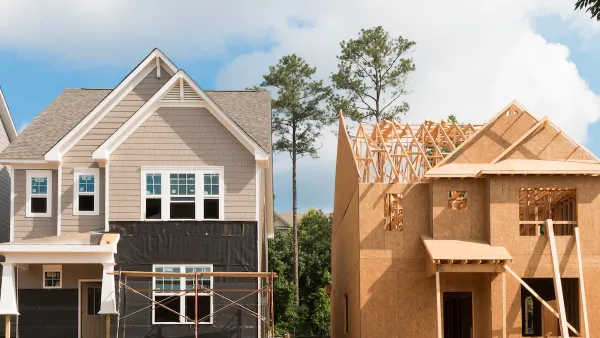
Commentary: When Neighborhood Change is Inevitable
Changes in the size and type of housing can accommodate different living arrangements and offer opportunities for multigenerational living and aging in place.

Seattle Works To Revise Comprehensive Plan
The city has developed five concepts for updating its comprehensive plan to increase density and reverse the legacy of exclusionary zoning.
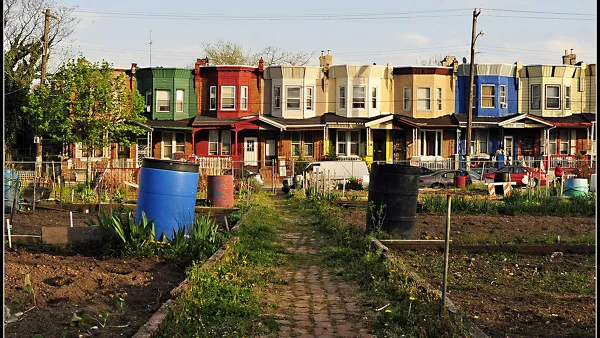
An Urban Lesson From the DNC's Host City
While Democrats consider the future of the country, the host city of the DNC offers a great urban lesson from the past: the elegant efficiency of rowhouses.

Planetizen Federal Action Tracker
A weekly monitor of how Trump’s orders and actions are impacting planners and planning in America.

The state-sanctioned urbicide of Austin
People don’t kill cities. Freeways do.

US to reduce Colorado River water deliveries to Mexico
A new Colorado Treaty amendment reduces Mexico’s Colorado River water allocation by 250,000 acre feet.

Nation's most wind-powered state turns to coal as data centers increase energy demand
For the first time in decades, Iowa has increased its generation of coal power.

NYC cools commuters with city's first rain garden above a bus stop
New York City officials say the plants in the rain garden can absorb 16 gallons of rainwater during heavy storms.

Brightline West’s future may rely on $6 billion federal loan
The company has until Nov. 2 to make a $400 million equity investment into its proposed high-speed rail line.

FREE Course: Walkable City 1: Why Walkability?
After describing his path towards focusing on walkability as the essence of good planning, Jeff Speck marches through his five principal reasons for making more walkable places.
Reinventing Malls: Planning Alchemy—Turning Gray Fields Into Gold
The course focuses on the opportunities and imperatives that shape reinvention of mall sites.

Greater Baltimore Committee
Eagle County Government
Harvard University Graduate School of Design
The Architects Foundation
University of Cincinnati Online
The Pocatello Development Authority
The Urban Renewal Agency of the City of Pocatello
Journal of the American Planning Association