Swedish cities are encouraging designers to dramatically reimagine the humble water tower.


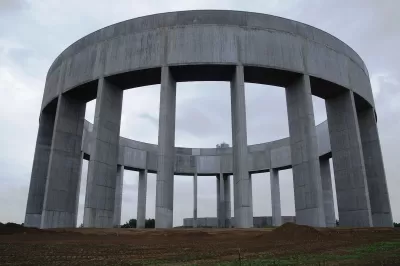
A recent trend in Sweden is replacing the country’s aging water towers with radically different designs akin to Modernist architecture. As Nate Berg explains in Fast Company, the trend began in Varberg, where the city held a design competition for a new water tower when the city’s old water system sprang a leak.
Cast in stark concrete and perched atop a small hill, the water tower has the unusual form of a long and narrow rectangle propped up on nine slender pillars. Scalloped along its lengths with subtle curves that recall waves of the nearby coast, the water tower is a radical departure from the bulbous and cylindrical tanks found in cities around the world.
While water tower design is largely dictated by utility — stipulations for the contest included water capacity and safety considerations — the competition called for a design that would become a local landmark that communicates “creativity, slenderness, comfort, and strength.”
The unique Varberg tower sparked a rash of other design contests around the country as cities replace old water towers and build new ones to accommodate population growth. “Advanced design tools and hydrological modeling software are now making it possible for the design of these water towers to take inventive new forms. One new water tower, built in the city of Helsingborg, is shaped like a large floating ring.”
Read the full story: Sweden just turned the humble water tower into art

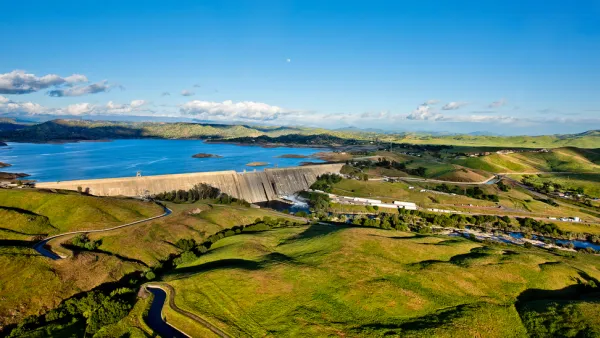
California Reservoir Project at Risk of Forfeiting $171 Million in State Funding
The Temperance Flat Reservoir Project might be falling too far behind schedule to maintain a huge chunk of state funding, according to reports.
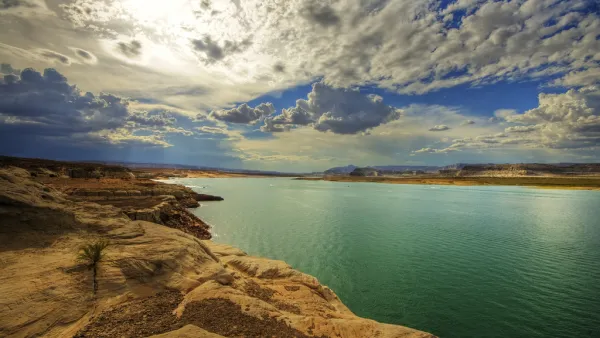
Arizona Revisits Plans for Withdrawing Water Reserves
Arizona has excelled at storing water in preparation for future droughts. The challenge now is how cities will access that water when they need it.
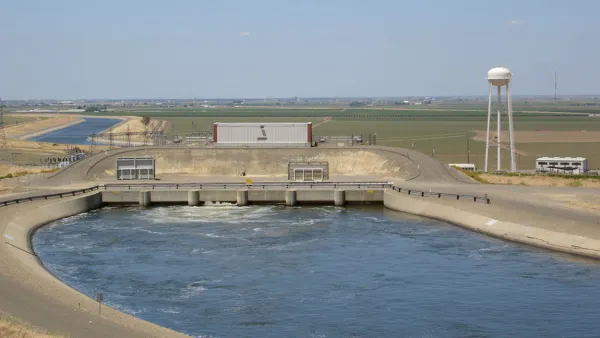
$13 Billion in Water Bonds Headed for the California Ballot in 2018
The legislature placed a $4.1 billion water bond on the ballot in June while a privately funded initiative hopes to qualify an $8.9 billion water bond for the November ballot. The state measure would also fund parks and trails.

Planetizen Federal Action Tracker
A weekly monitor of how Trump’s orders and actions are impacting planners and planning in America.

The state-sanctioned urbicide of Austin
People don’t kill cities. Freeways do.

Colorado’s Largest Data Center Could Rise Next to Homes — Without a Public Hearing
The proposed campus would consume 11 times the power of Denver International Airport; as it has across the country, opposition mounts.

Nation's most wind-powered state turns to coal as data centers increase energy demand
For the first time in decades, Iowa has increased its generation of coal power.

NYC cools commuters with city's first rain garden above a bus stop
New York City officials say the plants in the rain garden can absorb 16 gallons of rainwater during heavy storms.

Brightline West’s future may rely on $6 billion federal loan
The company has until Nov. 2 to make a $400 million equity investment into its proposed high-speed rail line.

FREE Course: Walkable City 1: Why Walkability?
After describing his path towards focusing on walkability as the essence of good planning, Jeff Speck marches through his five principal reasons for making more walkable places.
Reinventing Malls: Planning Alchemy—Turning Gray Fields Into Gold
The course focuses on the opportunities and imperatives that shape reinvention of mall sites.


Greater Baltimore Committee
Eagle County Government
Harvard University Graduate School of Design
The Architects Foundation
University of Cincinnati Online
The Pocatello Development Authority
The Urban Renewal Agency of the City of Pocatello
Journal of the American Planning Association