Lime will share its data with Washington, D.C., and Bloomington, Indiana, to help improve the equity, safety, accessibility of their transportation systems.


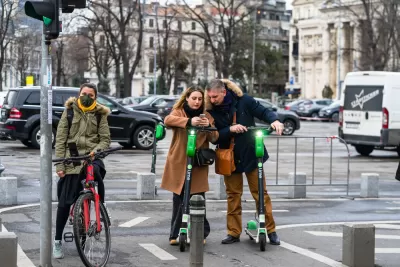
According to an article from Government Technology, “A major U.S. bike-share operator has chosen two U.S. cities with which to share its data while partnering with them to expand equity, and the reaches of micromobility in the larger transportation ecosystem.” Out of a dozen cities that applied to the 2024 Mobility Insights Competition organized by Lime and the League of American Bicyclists, Washington D.C. (pop. 671,803), and Bloomington, Indiana (pop. 79,107) were selected on May 29.
Lime told Government Technology that both cities stood out for “recognizing the ways shared micromobility data can speak to broader issues in the transportation system, including safety, equity, and accessibility,” reports senior writer Skip Descant.
Lime will now share its “extensive collection of data detailing trips, survey responses, and safety and other metrics” and work with the winning cities to help them analyze the data and gain a better understanding of their biking issues and address transportation challenges. “It’s the melding of tech, policy and infrastructure that creates modern, relevant transportation features like mobility hubs, or streets reimagined for more than just cars, Gene Oh, Tranzito CEO, said recently,” writes Descant.
Read the full story: Washington, D.C., Bloomington, Ind., Work With Lime on Mobility
Scooter Companies Convene Advisory Groups to Promote Safety
Both Bird and Lime have organized boards of experts to conduct research and advise the companies as their micromobility ventures grow.

Making Shared Micromobility More Inclusive
Cities and shared mobility system operators can do more to include people with disabilities in planning and operations, per a new report.
Biking Outpaces Transit Use in DC
D.C. residents and visitors take as many as 30 million trips on bikes or shared mobility, yet bike lanes cover just one quarter of one percent of the District’s streets.

Planetizen Federal Action Tracker
A weekly monitor of how Trump’s orders and actions are impacting planners and planning in America.

Eastern Nebraska is running out of electricity
Data centers and electrification are straining eastern Nebraska’s grid, throttling economic development.

Study reveals best places in the U.S. for cycling, walking
New research from Streetlight Data examines bicycle and pedestrian miles per capita in the 100 largest U.S. cities by population.

DSA members accuse Mamdani of 'abandoning values' over housing redevelopment
New York City's mayor plans to replace about 2,000 units of public housing with private, mixed-income housing.

All sides of BRT debate unhappy with CDOT’s most recent move
The Colorado Department of Transportation is no longer considering center-running bus lanes for Colorado Boulevard.

Massachusetts bogs generate both power, and cranberries
Putting solar panels above farmland is one way Massachusetts is advancing toward its goal of net-zero carbon emissions by 2050.

FREE Course: Walkable City 1: Why Walkability?
After describing his path towards focusing on walkability as the essence of good planning, Jeff Speck marches through his five principal reasons for making more walkable places.
Reinventing Malls: Planning Alchemy—Turning Gray Fields Into Gold
The course focuses on the opportunities and imperatives that shape reinvention of mall sites.

City of Rosemead
Rutgers University, Edward J. Bloustein School of Planning and Public Policy
One Hundred Miles
University of Michigan School for Environment and Sustainability (SEAS)
Hunter College, City University of New York (CUNY)
The Architects Foundation
City of Cambridge
The Pocatello Development Authority
The Urban Renewal Agency of the City of Pocatello