The ambitious 6,000-acre project will combine an 800-megawatt solar farm with crop and livestock production.



Ohio state officials have approved a 800-megawatt solar project on 6,000 acres about 25 west of Columbus, the state’s capital. The Oak Run Solar project in Madison County will co-locate 4,400 acres of solar panels and storage with production of sheep and crops, a practice called agrivoltaics, reports the Columbus Dispatch. At a cost of $1 billion, it will be the largest project of its kind in the country, and produce enough electricity to power 170,000 homes and $8.2 million in annual tax revenue.
The Ohio Siting Board approved the project, which will be built on land partially owned by Bill Gates, though it was opposed by local officials, who said the project doubles the amount of prime farmland in the county that will be taken out of production because of solar uses. It’s a concern the practice of agrivoltaics seeks to mitigate by planting crops along the edges of solar fields and allowing livestock to graze between the panels. “In the first year of operation, Oak Run must graze at least 1,000 sheep and grow crops on 2,000 acres. Within eight years of operation, at least 70% of the farmable project area, or at least 4,000 acres, must include agrivoltaics,” reports Mark Williams for the Dispatch.
The development company, Savion, says construction could begin in 2025.
FULL STORY: Mega Madison County solar farm with Bill Gates connection wins Ohio approva

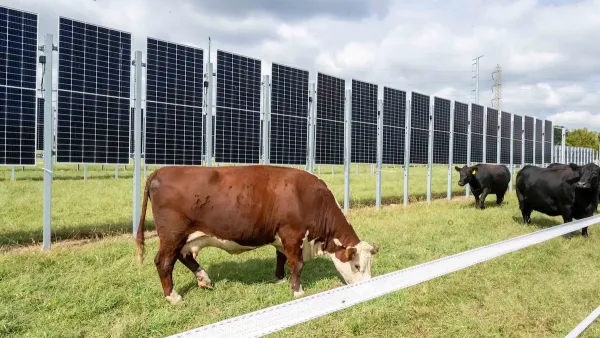
New Jersey Agrivoltaic Project Combines Solar Energy With Farming
A Rutgers University-New Brunswick demonstration farm will evaluate solar array designs to understand how they can best support grazing and agriculture on the same site.
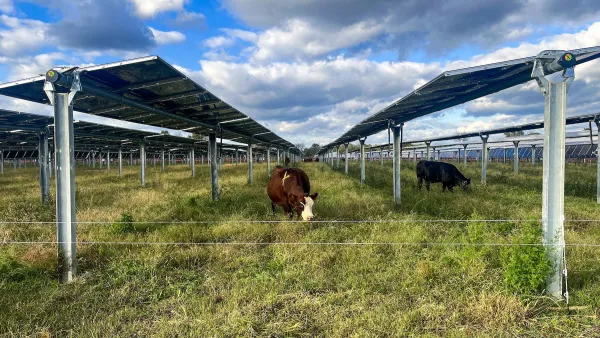
Cows at Tennessee's 'Silicon Ranch' graze under solar panels
The project aims to prove that agriculture and solar energy production can work in tandem.
Solar Panels Coming to a Self-Storage Facility Rooftop Near You
The sixth-largest self-storage company in the United States will add solar panels to 8.5 million square feet of its facilities’ rooftops to produce community solar power.

Planetizen Federal Action Tracker
A weekly monitor of how Trump’s orders and actions are impacting planners and planning in America.

The state-sanctioned urbicide of Austin
People don’t kill cities. Freeways do.

US to reduce Colorado River water deliveries to Mexico
A new Colorado Treaty amendment reduces Mexico’s Colorado River water allocation by 250,000 acre feet.

Guerilla urbanists are building DIY bus stop benches in Chicago
A before-and-after of one of the bus stops with a new bench. The new benches are not officially sanctioned or permitted, but the residents who placed them hope they will be the start of a network of DIY benches across the city.

Mamdani overhauls NYC's Vision Zero plan with 100 new policy goals
The overhaul aims to reduce traffic deaths and make streets safer for pedestrians, cyclists and drivers through lower speed limits, new safety infrastructure and more.

Amtrak not solely to blame for New Jersey commuter rail's unreliability, report finds
A new study from the Garden State Initiative found that NJ Transit’s budget grew 20% across a 4 year period, but reliability declined significantly over the same period.

FREE Course: Walkable City 1: Why Walkability?
After describing his path towards focusing on walkability as the essence of good planning, Jeff Speck marches through his five principal reasons for making more walkable places.
Reinventing Malls: Planning Alchemy—Turning Gray Fields Into Gold
The course focuses on the opportunities and imperatives that shape reinvention of mall sites.

Eagle County Government
Harvard University Graduate School of Design
Nashville Planning Department
The Architects Foundation
University of Cincinnati Online
The Pocatello Development Authority
The Urban Renewal Agency of the City of Pocatello
Journal of the American Planning Association