The long-delayed new tunnel linking New York and New Jersey will begin construction in the next month.


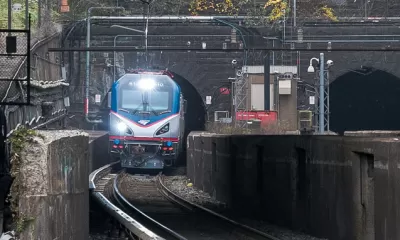
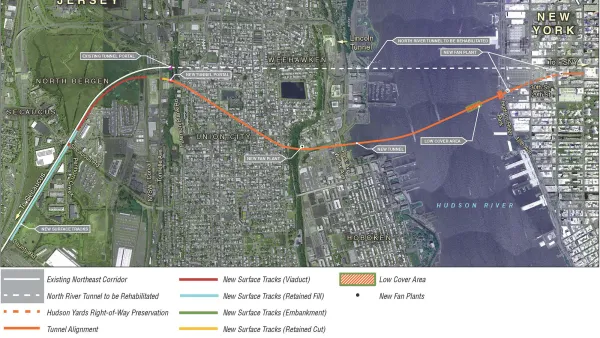
According to an article by Skylar Woodhouse in Bloomberg CityLab, “Evidence of the $16.1 billion, long-delayed, once-canceled effort to build a new tunnel linking New York and New Jersey will finally start appearing on Manhattan streets in the coming weeks.”
As Woodhouse explains, “A predecessor tunnel project, with full funding in place, had started construction when it was canceled by then-New Jersey Governor Chris Christie in 2010, who said the state couldn’t afford it,” while a renewed effort stalled during the Trump administration. “Gateway is key to easing congestion under the Hudson River, a choke point on the Northeast Corridor that runs between Boston and Washington, the country’s busiest passenger-train route.”
The Gateway project got a boost when President Biden awarded it a $292 million grant. The project also received a $6.9 billion grant from the Federal Transit Administration (FTA), the largest ever awarded. The tunnel could go into service in 2035.
Read the full story: NYC’s Long-Awaited Rail Tunnel Set to Get Shovels in the Ground
Gateway Tunnel Awarded Largest-Ever Federal Transit Grant
The $6.8 billion federal grant will fund the construction of a new tunnel at a key crossing under the Hudson River to supplement and replace tunnels damaged in Hurricane Sandy.
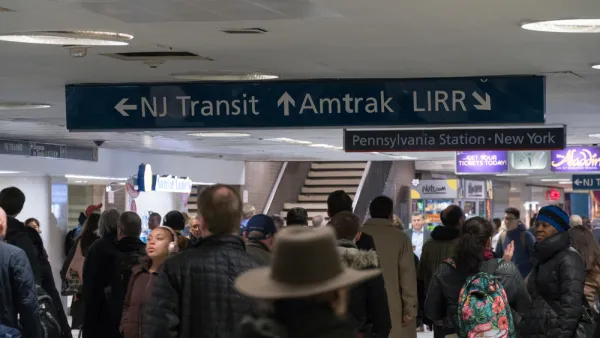
Biden Would Finally Get the Gateway Project Moving, Advocates Say
A group of regional experts and advocates provide details on how a win by former Vice President Joe Biden might change the direction of the Gateway Project to repair the rail link between New Jersey and New York.
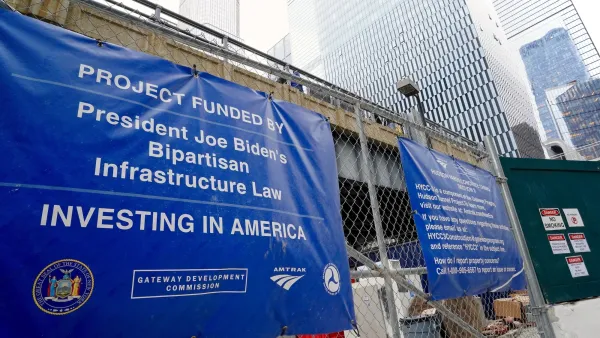
NYC-NJ Gateway Tunnel Project to Stop Work Next Week if DOT Doesn’t Release Funding
The federal government hasn’t released funding frozen during last October’s government shutdown.

Planetizen Federal Action Tracker
A weekly monitor of how Trump’s orders and actions are impacting planners and planning in America.

California plans to bury El Niño’s downpour
If the state plays its cards right, it may be able to store a billion acre-feet of El Niño’s water in aquifers.

Desperate measures: Advocates weigh draining Lake Powell to fill Colorado River
Draining the reservoir could reduce evaporation losses by a couple hundred thousand acre-feet.

Mamdani’s pied-à-terre tax survives legal challenge
A panel of judges found that the plaintiffs failed to demonstrate injury as a result of New York City's implementation of the tax.

Eastern Nebraska is running out of electricity
Data centers and electrification are straining eastern Nebraska’s grid, throttling economic development.

Seattle passes record-breaking transit services expansion
Proposition 1 will double the city’s transit tax to add 95,000 more bus trips and preserve 180,000 bus trips annually.

FREE Course: Walkable City 1: Why Walkability?
After describing his path towards focusing on walkability as the essence of good planning, Jeff Speck marches through his five principal reasons for making more walkable places.
Reinventing Malls: Planning Alchemy—Turning Gray Fields Into Gold
The course focuses on the opportunities and imperatives that shape reinvention of mall sites.

City of Rosemead
Rutgers University, Edward J. Bloustein School of Planning and Public Policy
One Hundred Miles
University of Michigan School for Environment and Sustainability (SEAS)
Hunter College, City University of New York (CUNY)
The Architects Foundation
City of Cambridge
Montrose County
The Pocatello Development Authority