After Governor Hochul’s statewide housing plan collapsed during budget talks, the city will weigh a series of zoning changes that could increase housing production and remove barriers to sustainability retrofits.



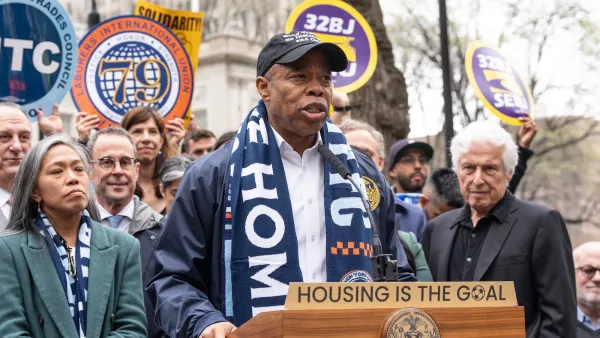
New York’s City Planning Commission will begin weighing three zoning amendments proposed by Mayor Eric Adams that would lower barriers for development, encourage more housing production, and help the city achieve its climate goals.
According to a Politico article by Janaki Chadha and Danielle Muoio Dunn, “The Adams administration is seeking to remove zoning barriers that inhibit the city’s carbon reduction goals, via a raft of changes that would, among other things, make it easier to pursue environmentally-friendly retrofits to buildings and legalize solar canopies on more than 8,500 acres of parking lots.”
Last week, opposition from largely suburban state lawmakers led to the collapse of Governor Kathy Hochul’s ambitious and controversial proposal to expand housing options and build 800,000 new housing units in New York State in the next decade.
As the article explains, the amendments will make their way through public review throughout the coming year. “The second zoning amendment, which is expected to enter public review this fall, seeks to lift arcane and outdated zoning rules that can be onerous to businesses and limit economic growth. And the third proposal, slated to move into public review next spring, would offer a density-bonus for affordable housing and make other changes to boost residential development around the city.”
Read the full story: City to advance first of three zoning amendments
What Actually Got Built Under Eric Adams’ ‘Pro-Housing’ Administration
The outgoing mayor claims credit for hundreds of thousands of new homes. The truth is more complicated.

NYC Council Approves Brooklyn Rezoning Plan
The Atlantic Avenue Mixed Use Plan includes infrastructure investments and could bring 4,600 new housing units to parts of Brooklyn.

Lawsuit Aims to Stop NYC’s ‘City of Yes’ Zoning Reforms
A lawsuit brought by local lawmakers and community groups claims the plan failed to conduct a comprehensive environmental review.

Planetizen Federal Action Tracker
A weekly monitor of how Trump’s orders and actions are impacting planners and planning in America.

California plans to bury El Niño’s downpour
If the state plays its cards right, it may be able to store a billion acre-feet of El Niño’s water in aquifers.

Desperate measures: Advocates weigh draining Lake Powell to fill Colorado River
Draining the reservoir could reduce evaporation losses by a couple hundred thousand acre-feet.

Mamdani’s pied-à-terre tax survives legal challenge
A panel of judges found that the plaintiffs failed to demonstrate injury as a result of New York City's implementation of the tax.

Eastern Nebraska is running out of electricity
Data centers and electrification are straining eastern Nebraska’s grid, throttling economic development.

Seattle passes record-breaking transit services expansion
Proposition 1 will double the city’s transit tax to add 95,000 more bus trips and preserve 180,000 bus trips annually.

FREE Course: Walkable City 1: Why Walkability?
After describing his path towards focusing on walkability as the essence of good planning, Jeff Speck marches through his five principal reasons for making more walkable places.
Reinventing Malls: Planning Alchemy—Turning Gray Fields Into Gold
The course focuses on the opportunities and imperatives that shape reinvention of mall sites.

City of Rosemead
Rutgers University, Edward J. Bloustein School of Planning and Public Policy
One Hundred Miles
University of Michigan School for Environment and Sustainability (SEAS)
Hunter College, City University of New York (CUNY)
The Architects Foundation
City of Cambridge
Montrose County
The Pocatello Development Authority