Grazing goats can quickly and effectively clear steep or hard-to-reach hillsides of invasive, fire-fueling vegetation.


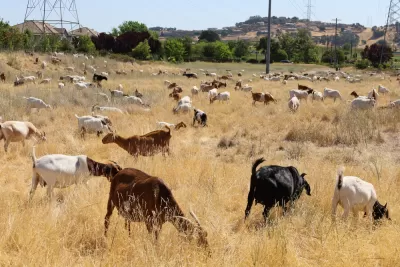
“The buildup of dead vegetation in parkland and wilderness areas, along with the effects of climate change, has accelerated the trend of devastating wildfires in California. In 2021, the state lost more than two million acres of wilderness to wildfire, and megablazes fires that burn more than 100,000 acres are becoming increasingly common.” As Chris Iovenko reports in National Geographic, Californians are increasingly turning to a time-tested method of fire management.
“Prior to fire seasons in the past, land managers traditionally relied on herbicide and human labor to thin plants and brush to reduce fuel load, the amount of flammable material that can burn in a fire. But access to mountain terrain in southern California can be challenging, and such traditional clearing practices can leave behind seeds that germinate the next year.” Enter goats.
“Deploying goats to clear land of vegetation is an age-old practice, but as wildfires worsen worldwide, places as diverse as Greece, Australia, and other parts of the U.S., such as Arizona and Colorado are embracing the herbivores as important tools for wildfire prevention.” Iovenko describes how grazing goats are deployed by California companies to manage flammable material. While research from California is scarce, studies from Arizona, Australia, and Greece show that goats can be an effective tool against wildfires.
FULL STORY: Goats may help prevent wildfires in California as drought worsens

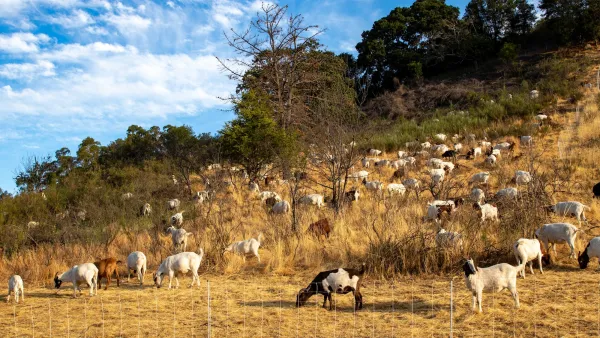
LA is Using 500 Goats to Clear Vegetation on Olympic Practice Fields
Grazing as a wildfire prevention tool is one of the most eco-friendly ways to clear dry brush and remove invasive plants.

NorCal's First Certified ‘Wildfire-Resilient’ Community Opens Near Sacramento
The 24-home Stone Canyon development goes beyond California’s building code for fire-resistant individual homes to include neighborhood-level fire resilience standards.
Don't Cement Our Future: Rethinking LA’s Landscape After Fire (and Floods)
A call for regenerative approaches to rebuilding that work with nature rather than against it.

Planetizen Federal Action Tracker
A weekly monitor of how Trump’s orders and actions are impacting planners and planning in America.

The state-sanctioned urbicide of Austin
People don’t kill cities. Freeways do.

US to reduce Colorado River water deliveries to Mexico
A new Colorado Treaty amendment reduces Mexico’s Colorado River water allocation by 250,000 acre feet.

5 New England states march closer to 800 megawatt wind energy project
Securing federal approval for the project may be complicated under the Trump administration, which has historically been hostile towards domestic wind power.

Baltimore to break ground on $50 million Transit Priority Project
The project will bring faster bus trips, safer streets and better bike connections to Baltimore.

Airbnb launches $250 million 'last-dollar financing' housing accelerator, makes first investment in Austin
The company will put $6.4 million towards affordable housing development in Texas’ capital.

FREE Course: Walkable City 1: Why Walkability?
After describing his path towards focusing on walkability as the essence of good planning, Jeff Speck marches through his five principal reasons for making more walkable places.
Reinventing Malls: Planning Alchemy—Turning Gray Fields Into Gold
The course focuses on the opportunities and imperatives that shape reinvention of mall sites.

Eagle County Government
Harvard University Graduate School of Design
Nashville Planning Department
The Architects Foundation
University of Cincinnati Online
The Pocatello Development Authority
The Urban Renewal Agency of the City of Pocatello
Journal of the American Planning Association