An ordinance under consideration by the Dallas City Council would change the parking requirements in the zoning code to allow for more density in exchange for affordable housing.


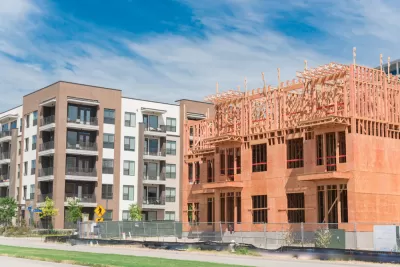
[Updated April 29, 2022] Lori Brown reports for Fox 4 in Dallas: “City staff says the need for affordable housing in Dallas has reached a crisis level. But the city says its current plan offering incentives to developers isn't working.”
The debate is taking place as the Dallas City Council considers a proposed ordinance that would “allow developers to build more dense apartment complexes with fewer parking spaces in exchange for creating on or off-site affordable housing,” according to Brown.
“The city currently requires five parking spaces for every four apartment units. City staff is recommending a dramatic cutdown to one parking space for every two apartment units.”
The article includes soundbites from a public hearing on the ordinance, in which residents from around the city, and their elected officials, express resistance to the idea of adding multi-family housing and new density to residential neighborhoods. City planning staff, however, recommends the change as a tool to ensure the development of more housing attainable for lower-income households as the city reckons with low inventories and increasing prices.
The City Council could vote on the parking reforms by May 11.
Previous Planetizen coverage of Dallas’ parking reform efforts:
- Dallas Exploring Parking Requirement Reform (December 2021)
- Fixing Decades-Old Parking Regulations in Dallas (March 2021)
[Update]: Planetizen received the following information via email from Steven Doss from the Dallas Planning and Urban Design Department, who explains that the ordinance described in this article is better described as a housing proposal that includes an enhanced parking reduction:
"The item discussed by City Council on 4/20/2022 is actually an expansion of an already-existing Mixed Income Housing Development Bonus program. The existing program allows for density, height, unit number, FAR, and other development bonuses (including a parking reduction) in exchange for the voluntary provision of units reserved for lower income renters (bonuses depend on the percent of reserved units and the income band, based on AMI). These bonuses apply to by-right development, so an applicant can obtain these bonuses without going through any zoning process if the property is already correctly zoned. They decide to take advantage of the program at the permitting stage.
"The proposal discussed this week essentially adds a new tier of bonus options that developers can use when they need to build in a Planned Development district. These proposed new bonuses provide a menu of additional development rights to provide flexibility in exchange for reserving units for different income tiers in different markets within the city. In general, higher bonuses are available for developments that reserve units for lower income tiers. While most of the Council discussion centered on parking requirements (staff recommendation is to reduce the current 1.25 spaces per unit to 0.5 spaces per unit), there was are a whole host of other proposed amendments."
Doss also adds that the Planning and Urban Design Department is continuing to work on the larger parking reforms described in the previous Planetizen coverage linked above, and is expecting to present a refined set of proposed parking reforms for consideration by the Dallas Zoning Ordinance Advisory Committee (a committee appointed by the City Plan Commission) this summer.
More information on the proposed amendments can be found on the city’s project webpage.
A video of the City Council Meeting at which the proposal was discussed is also available online. The Council will discuss the item again at the May 11 meeting with the potential to make a final decision.
FULL STORY: Dallas City Council considers changing parking requirements for apartment developments

Dallas Exploring Parking Requirement Reform
Dallas relies on a formula introduced in 1965 to determine parking requirements for new developments, but city planners are studying how to update the city's development code for the future.
Fixing Decades-Old Parking Regulations in Dallas
Dallas has launched an effort to reform its "burdensome" parking policies, which have been left largely in the hands of local development districts.
Parking, Density, and Affordable Housing in California
A bill to reduce parking minimums for residential or mixed-use developments that include affordable units passed a key Senate committee. AB 744 amends the state's density bonus law, itself controversial, that incentivizes building affordable housing.

Planetizen Federal Action Tracker
A weekly monitor of how Trump’s orders and actions are impacting planners and planning in America.

The state-sanctioned urbicide of Austin
People don’t kill cities. Freeways do.

US to reduce Colorado River water deliveries to Mexico
A new Colorado Treaty amendment reduces Mexico’s Colorado River water allocation by 250,000 acre feet.

Airbnb launches $250 million 'last-dollar financing' housing accelerator, makes first investment in Austin
The company will put $6.4 million towards affordable housing development in Texas’ capital.

Guerilla urbanists are building DIY bus stop benches in Chicago
A before-and-after of one of the bus stops with a new bench. The new benches are not officially sanctioned or permitted, but the residents who placed them hope they will be the start of a network of DIY benches across the city.

Mamdani overhauls NYC's Vision Zero plan with 100 new policy goals
The overhaul aims to reduce traffic deaths and make streets safer for pedestrians, cyclists and drivers through lower speed limits, new safety infrastructure and more.

FREE Course: Walkable City 1: Why Walkability?
After describing his path towards focusing on walkability as the essence of good planning, Jeff Speck marches through his five principal reasons for making more walkable places.
Reinventing Malls: Planning Alchemy—Turning Gray Fields Into Gold
The course focuses on the opportunities and imperatives that shape reinvention of mall sites.

Eagle County Government
Harvard University Graduate School of Design
Nashville Planning Department
The Architects Foundation
University of Cincinnati Online
The Pocatello Development Authority
The Urban Renewal Agency of the City of Pocatello
Journal of the American Planning Association