The Chamblee City Council has approved a massive new development project that will add more than 700 homes and tens of thousands of square feet of retail to the quickly growing city.


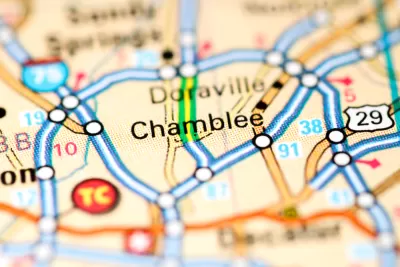
The city of Chamblee, Georgia, a suburb of Atlanta located in DeKalb County, has approved zoning changes for the development of 62 parcels, yielding 700 homes and 20,000 square feet of retail uses.
Zachary Hansen reports on developer Thrive Residential's (a subsidiary of Toll Brothers Inc.) plan to build the Chamblee Park development on 31 acres near Interstate 285 and Peachtree Boulevard.
The new development mostly provoked support from residents and city leaders, "with the only point of contention being access to the site," according to Hansen. The City Council did impose 13 conditions for the rezoning: "The site will be built around Parsons Drive and Deacon Lane, realigning the existing roads, adding sidewalks and creating a central roundabout. A shuttered church building and a few standalone homes in the area will be demolished as part of the project."
Prior to the City Council's vote, "the developer had to seek and obtain approval from the Atlanta Regional Commission to continue" due to the size of the project, according to Hansen.
"The project will boost housing stock in Chamblee, which experienced a higher rate of population growth than any other DeKalb County city over the past decade. According to the 2020 Census, Chamblee’s population grew 205% since 2010, which city leaders chalked up to several annexations," adds Hansen for context.
Read the full story: Chamblee rezones site for sprawling mixed-use development with 700 homes
Texas Could Have the Nation’s 3 Largest Cities by 2100. Are They Ready to Embrace Density?
Houston, Dallas, and Austin are growing fast. The old sprawl model is no longer sustainable.
Cities in the South and West Keep Sprawling
New suburbs continue to expand into previously undeveloped areas, putting strain on local resources.
A New Metropolitan Blueprint for Texas
Traditionally associated with its wide-open spaces, Texas is now, undeniably, defined by the cities and suburbs that comprise its built environment.

Planetizen Federal Action Tracker
A weekly monitor of how Trump’s orders and actions are impacting planners and planning in America.

California plans to bury El Niño’s downpour
If the state plays its cards right, it may be able to store a billion acre-feet of El Niño’s water in aquifers.

Desperate measures: Advocates weigh draining Lake Powell to fill Colorado River
Draining the reservoir could reduce evaporation losses by a couple hundred thousand acre-feet.

Mamdani’s pied-à-terre tax survives legal challenge
A panel of judges found that the plaintiffs failed to demonstrate injury as a result of New York City's implementation of the tax.

Eastern Nebraska is running out of electricity
Data centers and electrification are straining eastern Nebraska’s grid, throttling economic development.

Seattle passes record-breaking transit services expansion
Proposition 1 will double the city’s transit tax to add 95,000 more bus trips and preserve 180,000 bus trips annually.

FREE Course: Walkable City 1: Why Walkability?
After describing his path towards focusing on walkability as the essence of good planning, Jeff Speck marches through his five principal reasons for making more walkable places.
Reinventing Malls: Planning Alchemy—Turning Gray Fields Into Gold
The course focuses on the opportunities and imperatives that shape reinvention of mall sites.

City of Rosemead
Rutgers University, Edward J. Bloustein School of Planning and Public Policy
One Hundred Miles
University of Michigan School for Environment and Sustainability (SEAS)
Hunter College, City University of New York (CUNY)
The Architects Foundation
City of Cambridge
Montrose County
The Pocatello Development Authority