The low-slung, car-oriented apartment buildings represent a mid-century solution to a housing shortage and offer valuable lessons for new development.


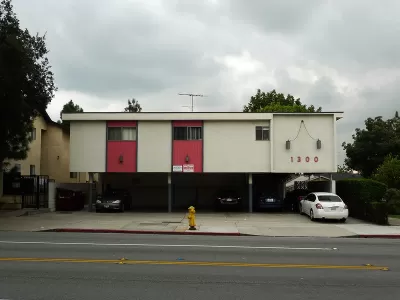
Describing the "aggressively economical" icon of mid-density apartment buildings known as dingbats that pepper Los Angeles from the Valley to the Eastside, Laura Bliss writes that these buildings "were a multifamily answer to that single-family template." These two- to three-story buildings include a carport on the bottom level and generally house six to 12 units. In the 1950s and 1960s, "[t]his new format for affordable multifamily living became nearly as ubiquitous as the single-family tract housing that iconified the much-mythologized Southern California suburban lifestyle."
Dingbats provided "an essential resource for a growing city: Los Angeles County added more than three million residents between 1940 and 1960, thanks to job booms in manufacturing and aerospace, educational opportunities for returning GIs, and the lure of year-round sunshine." Over 700,000 new units sprawled outward as new freeways made the periphery more accessible and the city swallowed up citrus orchards and ranches.
Today, dingbats, many of which are rent-stabilized, offer some important benefits as "a bastion of relatively affordable shelter" in a city facing a severe housing shortage. "Dingbats may also hold the possibility for accommodating further infill: Thanks to recent legal changes, it’s now possible to convert carports into accessory dwelling units, which some owners are beginning to do." These buildings exemplify the mid-century's answer to "missing middle housing" and "tell a story of when the city met the demands of the day with a low-cost, replicable, yet individualized housing form factor."
Read the full story: How Los Angeles Became the City of Dingbats


L.A. Tenants Hit With Sudden Rent Hikes Under 'Discounted Rent' Loophole
A legal loophole has allowed some Los Angeles landlords to sharply raise rents on apartments that would otherwise fall under the city's rent stabilization ordinance and pandemic-related rent freeze.
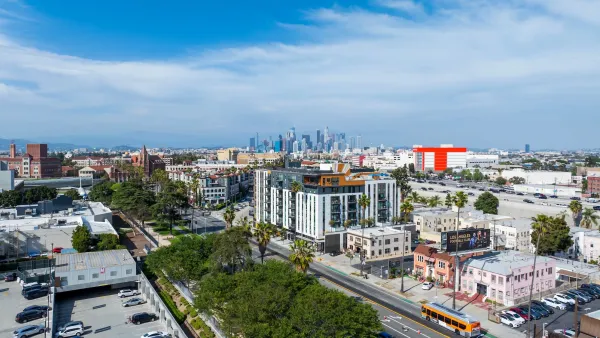
LA delays state housing mandate with 'low-rise ordinance'
The new ordinance allows the city to delay implementing SB 79, a state law requiring more density near transit.
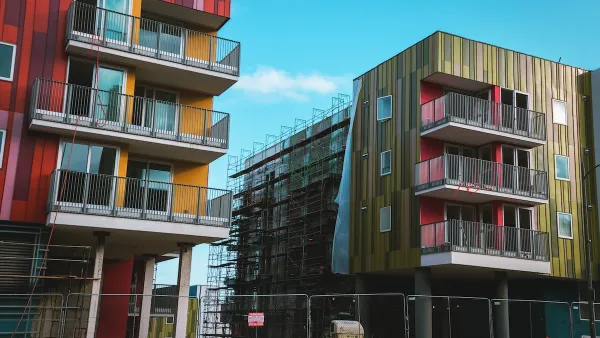
Survey: 59% of LA Residents Want Dense Housing in Their own Neighborhoods
A UCLA survey reveals strong support for new apartments across the city, bucking the notion that Angelenos are NIMBYs.

Planetizen Federal Action Tracker
A weekly monitor of how Trump’s orders and actions are impacting planners and planning in America.

Data reveals that NYC’s bet on congestion pricing has paid off
After almost two years of the program, reports show positive impacts on traffic and air quality and no disruptions to parking.

Denver is solving homelessness. Why aren't the rest of us?
Since 2023, Denver's street homeless population has decreased by 64%, proving that effective tools exist to support those in need of housing.

Michigan needs billions to save its water infrastructure. The state won't fund it
Michigan needs to invest $2.8 billion per year over the next 20 years to fix its water infrastructure. The FY 2027 budget allocates only $27.9 million.

Trump asks Supreme Court to allow border wall through Texas national park
Judge Kathleen Cardone previously blocked the Big Bend border wall project, and Texas’ Land Commissioner has spoken out against it as well.

This MA town is drowning in its own sewage — and residents like it that way
Susan Murcott, a waste water expert, said if Carlisle didn't address their leaking sewage, the problem could turn “deadly.”

FREE Course: Walkable City 1: Why Walkability?
After describing his path towards focusing on walkability as the essence of good planning, Jeff Speck marches through his five principal reasons for making more walkable places.
Reinventing Malls: Planning Alchemy—Turning Gray Fields Into Gold
The course focuses on the opportunities and imperatives that shape reinvention of mall sites.

City of Rosemead
Rutgers University, Edward J. Bloustein School of Planning and Public Policy
One Hundred Miles
The Architects Foundation
University of Cincinnati Online
Montrose County
Northern Illinois Transit Authority (NITA)
The Pocatello Development Authority