Learn more about the Resource Conservation District which promotes land stewardship and resource conservation in the mountains through habitat restoration, planning, research, and education.


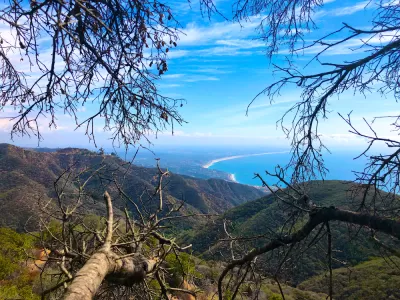
While many may have heard of the Santa Monica Mountains and appreciate their uniqueness, few probably know about the Resource Conservation District of the Santa Monica Mountains (RCDSMM). The mission of the RCDSMM is to promote land stewardship and resource conservation through ecological research, conservation planning and design, habitat restoration and environmental education. The RCDSMM encompasses the Santa Monica Mountains from Point Mugu to Topanga State Park and includes the Simi Hills, Santa Catalina Island, Pierce College, Sepulveda Basin Wildlife Area, and Chatsworth Reservoir.
As explained in this article by Jimy Tallal, even the COVID-19 pandemic has not slowed down the work of the RCDSMM. Highlights of RCDSMM's work in 2020 include (but are not limited to):
- Adding new distance-learning content to their environmental education offerings;
- Engaging community stakeholders in shaping the future of Topanga Lagoon;
- Completing the website on wildfire resilience and design phases for the Liberty Canyon Wildlife Crossing Project;
- Working with NASA's Jet Propulsion Laboratory to analyze areas of the Santa Monica Mountains that would be best for oak tree survival as the climate changes;
- Conducting ongoing monitoring to track the health of mature oak trees;
- Enlisting volunteer hikers to “adopt” and water newly planted oak seedlings on public lands until they become established;
- Starting an innovative program to use volunteers to teach community members how to recognize and report evidence of the beetles in native trees in neighborhoods, parks and wild areas;
- Continuing to conduct amphibian and turtle surveys throughout the Santa Monica Mountains; and
- Completing the architectural design and construction of a demonstration “house” that allows homeowners to see best management practices for hardening their structures against wildfire.
To learn more, please read the source article and visit RCDSMM's website.
Read the full story: Resource Conservation District Doing Good Things in the Santa Monica Mountains
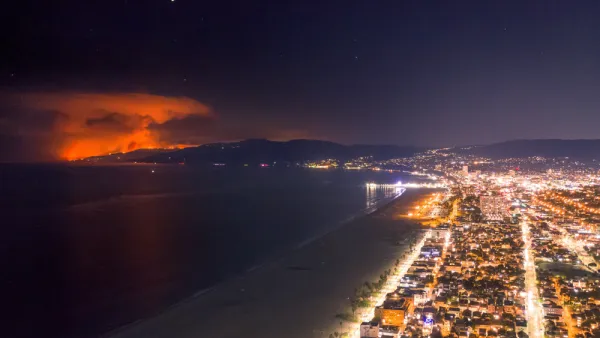
Wildfire Recovery for the Nation's Largest Urban Park
The National Park Service is seeking public comments on the redevelopment of sites within the Santa Monica Mountains National Recreation Area that were burned in the 2018 Woolsey Fire.
A Political Victory to Protect Wild Coastal Land
Los Angeles County Supervisor Zev Yaroslavsky discusses how the approval of new plans will preserve a stretch of unincorporated Southern California coastline.

After years of opposition to light rail, this L.A. city wants a $200 million station
Cerritos officials want the Southeast Gateway Line, a planned 14.5-mile light rail route through Los Angeles County, to stop in their city.

Desperate measures: Advocates weigh draining Lake Powell to fill Colorado River
Draining the reservoir could reduce evaporation losses by a couple hundred thousand acre-feet.

Eastern Nebraska is running out of electricity
Data centers and electrification are straining eastern Nebraska’s grid, throttling economic development.

Move over, LA: St. Louis gears up for Olympics, invests millions in downtown redevelopment
The Missouri city will host the 2028 Olympic soccer group stage and knockout matches.

MTA sends Dem leaders a wish list to mend Trump’s damages
Requests include exempting new train and bus components from tariffs and increasing transit security funding.

Mass. votes against statewide minimum lot size for single-family homes
Over 2 million residents voted on Question 7; it was decided by just over 30,000 votes.

Maryland’s $15 billion bridge project gains key approval
The Maryland Transit Authority said the project will create over 60,000 jobs and add $23 billion to the local economy.

FREE Course: Walkable City 1: Why Walkability?
After describing his path towards focusing on walkability as the essence of good planning, Jeff Speck marches through his five principal reasons for making more walkable places.
Reinventing Malls: Planning Alchemy—Turning Gray Fields Into Gold
The course focuses on the opportunities and imperatives that shape reinvention of mall sites.

City of Rosemead
Rutgers University, Edward J. Bloustein School of Planning and Public Policy
One Hundred Miles
University of Michigan School for Environment and Sustainability (SEAS)
Hunter College, City University of New York (CUNY)
The Architects Foundation
City of Cambridge
The Pocatello Development Authority
The Urban Renewal Agency of the City of Pocatello