Billed as a "bridge replacement," the latest iteration of the Columbia River Crossing project is a costly expansion that will impose new tolls and cost upwards of $5 billion, according to an article by Joe Cortright.


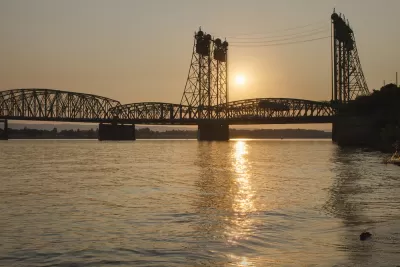
Writing in City Observatory, Joe Cortright criticizes the Columbia River Crossing (CRC) project as "vastly oversized and over-priced, with current cost estimates ranging as high as nearly $5 billion (before cost-overruns)." The project, a joint venture between the Oregon and Washington transportation departments, is now billed as a "bridge replacement," a euphemism that Cortright claims obscures the true impact of what amounts to "a massive freeway expansion."
According to Cortright, the project is "a five-mile long, 12-lane wide freeway that just happens to cross a river" that will cost $5 billion and impose $5 round-trip tolls on drivers. "While the agency is hinting at the possibility of “design” tweaks—it’s apparent that their plan is to simply recycle the failed CRC proposal."
FULL STORY: The real “I-5” project: $5 billion, 5 miles, $5 tolls

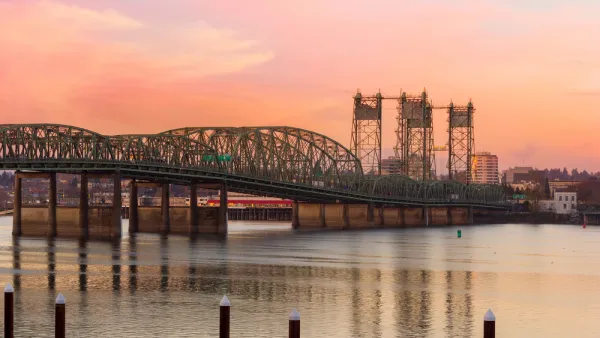
Columbia River Crossing Back From the Dead With a New Name and Potential Changes
2021 will be a big year for planning on the Interstate Bridge Replacement project, née Columbia River Crossing, that will connect Washington and Oregon across the Columbia River.
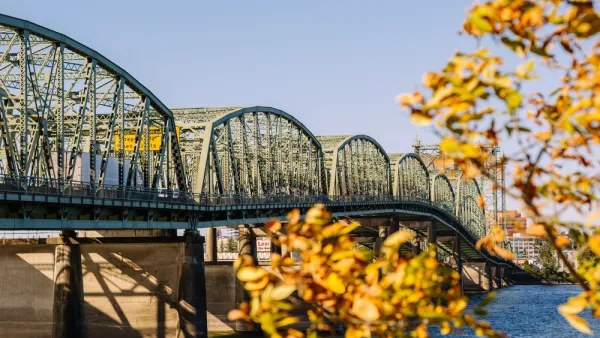
Once Abandoned, Now Accelerated: Columbia River Crossing Replacement Building Momentum
A project to build a new bridge between Portland and Washington State, once scuttled by Washington lawmakers, now has an aggressive timeline. There was some financial pressure involved in getting the project to its current status.
Reviving the Failed Columbia River Crossing to Connect Oregon, Washington
A project is back from the dead in the Pacific Northwest, at least in the eyes of the governors of Oregon and Washington.

The state-sanctioned urbicide of Austin
People don’t kill cities. Freeways do.

US to reduce Colorado River water deliveries to Mexico
A new Colorado Treaty amendment reduces Mexico’s Colorado River water allocation by 250,000 acre feet.

New Jersey’s second-largest city bans standalone data centers
Jersey City will continue to allow co-location facilities, such as those meant for research institutions that store their own data.

Amtrak not solely to blame for New Jersey commuter rail's unreliability, report finds
A new study from the Garden State Initiative found that NJ Transit’s budget grew 20% across a 4 year period, but reliability declined significantly over the same period.

EPA erases limits on planet-warming pollution from power plants
Under Monday’s plan, power plants would still have some limits on how much mercury, arsenic and other contaminants they can emit.

Phoenix announces new on-demand transit service, more frequent RAPID buses
Both new services will launch in October, and are part of Phoenix's Project Effective Access Solutions for Easing Congestion.

FREE Course: Walkable City 1: Why Walkability?
After describing his path towards focusing on walkability as the essence of good planning, Jeff Speck marches through his five principal reasons for making more walkable places.
Reinventing Malls: Planning Alchemy—Turning Gray Fields Into Gold
The course focuses on the opportunities and imperatives that shape reinvention of mall sites.

Eagle County Government
Harvard University Graduate School of Design
Nashville Planning Department
The Architects Foundation
University of Cincinnati Online
The Pocatello Development Authority
The Urban Renewal Agency of the City of Pocatello
Journal of the American Planning Association