A southwest Ohio city is updating its development code in response to a desire in the community to better protect the city's existing communities.



John Bush reports on the CodePiqua project in Pique, Ohio, which will generate a new development code and transportation plan for the city.
The CodePique effort grows out of Piqua's previous Plan It Piqua Comprehensive Plan, which recommended a code update for the city to better implement the goals set forth in the comprehensive plan.
"The purpose of the project is to put into place development standards that will promote neighborhood qualities that enhance existing developments and create a sense of a place. It also is meant to establish a new transportation plan that includes context sensitive standards for public right-of-way use and improvements," according to Bush.
Piqua Economic Development Director Chris Schmiesing is quoted in the article saying that the city's current development code is too generic to reflect the built environment of the city.
As for the transportation component of CodePiqua, Bush adds the following: "This initiative aims to help resolve many of the conflicts between modes of use, such as vehicles, bicycles and pedestrians. It will also help serve as a basis for future decision making by the Piqua Planning Commission, City Commission and Transportation Committee."
The city contracted Austin-based planning and code consultant Code Studio to work on CodePiqua. More information on the project is available on Code Studio's website.
Read the full story: New community planning project aims to improve economic development in Piqua

Development Code, Future Land Use Map Updates Coming to Dallas
The ForwardDallas initiative is attempting for the Holy Grail of planning: development certainty.

Auburn, Maine Approves New Residential and Commercial Densities Despite Public Outcry
Auburn, Maine offers the latest an example of a small city deciding to increase its capacity for future development in response to housing pressure, even in the face of intense public opposition.
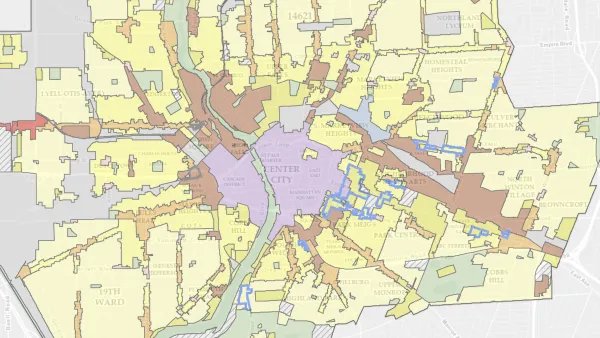
Rochester, New York Drafts a Zoning Map to Match its New Comprehensive Plan
The Rochester 2034 Zoning Alignment Project is implementing the award-winning Rochester 2034 Comprehensive Plan.

Planetizen Federal Action Tracker
A weekly monitor of how Trump’s orders and actions are impacting planners and planning in America.

Eastern Nebraska is running out of electricity
Data centers and electrification are straining eastern Nebraska’s grid, throttling economic development.

Washington state to charge fee to drivers with fuel-efficient cars
Revenue from the fee will go towards supporting the state’s highways.

Instead of building new housing, LA developers are turning mansions into mega-mansions
In the richest areas, the number of houses valued at $30 million with demolition permits has skyrocketed since 2018.

Illinois considers spending $1 billion in taxpayer money on data center
A quantum computing campus and data center are currently under construction in Chicago.

As development costs rise, Boston moves to lessen affordable housing requirements
The Boston Zoning Commission and the City Council still need to approve Boston Mayor Michelle Wu’s proposed changes

FREE Course: Walkable City 1: Why Walkability?
After describing his path towards focusing on walkability as the essence of good planning, Jeff Speck marches through his five principal reasons for making more walkable places.
Reinventing Malls: Planning Alchemy—Turning Gray Fields Into Gold
The course focuses on the opportunities and imperatives that shape reinvention of mall sites.

City of Charlotte
City of Rosemead
Rutgers University, Edward J. Bloustein School of Planning and Public Policy
University of Michigan School for Environment and Sustainability (SEAS)
Hunter College, City University of New York (CUNY)
The Architects Foundation
City of Cambridge
The Pocatello Development Authority
The Urban Renewal Agency of the City of Pocatello