The planner who wrote the book on the emerging practice of scenario planning offers advice on how the tool can be helpful in planning for the pandemic.


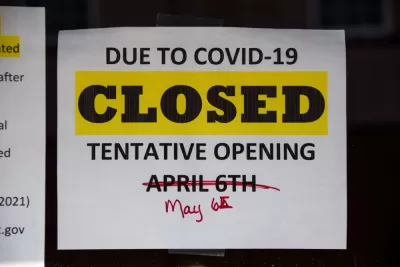
With the Covid-19 pandemic introducing countless uncertainties into the world, organizations ranging from hospitals to school districts to transit agencies are using scenario planning to plan for the future, according to an article and interview published by the Lincoln Institute of Land Policy.
The interview features Robert Goodspeed, an assistant professor of urban and regional planning at the University of Michigan, a board member of the Lincoln Institute's Consortium for Scenario Planning, and author of Scenario Planning for Cities and Regions: Managing and Envisioning Uncertainties (Lincoln Institute of Land Policy, April 2020). The interview touches on the kinds of organizations that could benefit most from scenario planning during and after the pandemic, recommendations for getting started with scenario planning, and examples of pandemic responses already generated by scenario planning.
Goodspeed will also participate in a webinar hosted by the Michigan chapter of the American Planning Association today, May 14, available for AICP CM credit.
FULL STORY: How Scenario Planning Can Shape Our Recovery Efforts


More Need Than Ever for Drought Resilience on the Colorado River
The effects of climate change are already cutting deeply into the lifeblood of the U.S. West—the Colorado River.

A New Tool for More Flexible and Resilient Water Policies
A new book created by the Sonoran Institute explains how exploratory scenario planning can be useful to prepare for the uncertainty of water in the near- and long-term future.
Parametric Modeling for Planning in Uncertain Times
A new technology- and data-drive approach to planning could provide direction as society faces challenges of unprecedented scale.

Planetizen Federal Action Tracker
A weekly monitor of how Trump’s orders and actions are impacting planners and planning in America.

The state-sanctioned urbicide of Austin
People don’t kill cities. Freeways do.

US to reduce Colorado River water deliveries to Mexico
A new Colorado Treaty amendment reduces Mexico’s Colorado River water allocation by 250,000 acre feet.

Guerilla urbanists are building DIY bus stop benches in Chicago
A before-and-after of one of the bus stops with a new bench. The new benches are not officially sanctioned or permitted, but the residents who placed them hope they will be the start of a network of DIY benches across the city.

Mamdani overhauls NYC's Vision Zero plan with 100 new policy goals
The overhaul aims to reduce traffic deaths and make streets safer for pedestrians, cyclists and drivers through lower speed limits, new safety infrastructure and more.

Amtrak not solely to blame for New Jersey commuter rail's unreliability, report finds
A new study from the Garden State Initiative found that NJ Transit’s budget grew 20% across a 4 year period, but reliability declined significantly over the same period.

FREE Course: Walkable City 1: Why Walkability?
After describing his path towards focusing on walkability as the essence of good planning, Jeff Speck marches through his five principal reasons for making more walkable places.
Reinventing Malls: Planning Alchemy—Turning Gray Fields Into Gold
The course focuses on the opportunities and imperatives that shape reinvention of mall sites.

Eagle County Government
Harvard University Graduate School of Design
Nashville Planning Department
The Architects Foundation
University of Cincinnati Online
The Pocatello Development Authority
The Urban Renewal Agency of the City of Pocatello
Journal of the American Planning Association