An article published by the Journal of the American Planning Association argues that single-family zoning "exacerbates inequality and undermines efficiency," and should be eliminated entirely.


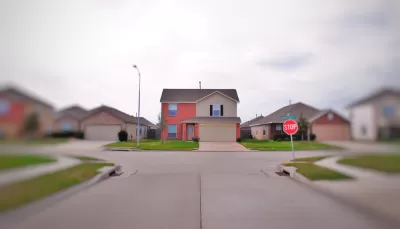
An article by Michael Manville, Paavo Monkkonen, and Michael Lens, published by the Journal of the American Planning Association (JAPA), calls for the end of single-family zoning.
From the abstract:
R1’s origins are unpleasant: Stained by explicitly classist and implicitly racist motivations, R1 today continues to promote exclusion. It makes it harder for people to access high-opportunity places, and in expensive regions it contributes to shortages of housing, thereby benefiting homeowners at the expense of renters and forcing many housing consumers to spend more on housing. Stacked against these drawbacks, moreover, are a series of only weak arguments in R1’s favor about preferences, aesthetics, and a single-family way of life.
The full article, which is behind the journal's paywall, debunks the pro-single-family zoning arguments and appeals to planners to entirely abolish single-family zoning.
Update, December 10, 2019: The same issue of JAPA includes another article by Jake Wegman, titled "Death to Single-Family Zoning…and New Life to the Missing Middle," that makes a similar case against single-family zoning. On Twitter, Wegman said "it's long past time for the planning profession to stop defending the indefensible" in a thread promoting the opinion article.
FULL STORY: It's Time to End Single-Family Zoning


Report: How Outdated Zoning Rules Still Shape Boston
Classist and racist zoning decisions from decades past reverberate in today’s neighborhoods.

'Monster Homes' Not the Desired Density Solution for Oahu
Questions of density, and how to add it to single-family neighborhoods, abound in this article focusing on Honolulu and other communities on Oahu.

White House Marks Juneteenth by Pushing for Zoning Reforms
On a holiday that commemorates the end of slavery in the United States, the White House marked the occasion by discussion exclusionary zoning.

The state-sanctioned urbicide of Austin
People don’t kill cities. Freeways do.

US to reduce Colorado River water deliveries to Mexico
A new Colorado Treaty amendment reduces Mexico’s Colorado River water allocation by 250,000 acre feet.

New Jersey’s second-largest city bans standalone data centers
Jersey City will continue to allow co-location facilities, such as those meant for research institutions that store their own data.

Amtrak not solely to blame for New Jersey commuter rail's unreliability, report finds
A new study from the Garden State Initiative found that NJ Transit’s budget grew 20% across a 4 year period, but reliability declined significantly over the same period.

EPA erases limits on planet-warming pollution from power plants
Under Monday’s plan, power plants would still have some limits on how much mercury, arsenic and other contaminants they can emit.

Phoenix announces new on-demand transit service, more frequent RAPID buses
Both new services will launch in October, and are part of Phoenix's Project Effective Access Solutions for Easing Congestion.

FREE Course: Walkable City 1: Why Walkability?
After describing his path towards focusing on walkability as the essence of good planning, Jeff Speck marches through his five principal reasons for making more walkable places.
Reinventing Malls: Planning Alchemy—Turning Gray Fields Into Gold
The course focuses on the opportunities and imperatives that shape reinvention of mall sites.

Eagle County Government
Harvard University Graduate School of Design
Nashville Planning Department
The Architects Foundation
University of Cincinnati Online
The Pocatello Development Authority
The Urban Renewal Agency of the City of Pocatello
Journal of the American Planning Association